Executive Summary · The Science of Mountain Offsites
Traditional corporate retreats held in urban conference hotels frequently fail because they replicate the identical digital distractions, social hierarchies, and sensory overload of daily office life. Relocating strategic leadership offsites to remote Himalayan mountain settings leverages Attention Restoration Theory (ART) to unburden prefrontal cognitive bandwidth, flattens organizational silos through shared physical terrain, and fosters the psychological safety essential for authentic annual planning, executive alignment, and team resilience.
In an era dominated by hyper-connected communication platforms, continuous calendar fragmentation, and asynchronous decision fatigue, the modern leadership team rarely experiences uninterrupted collective focus. When organizations convene to formulate multi-year strategies, resolve complex cross-functional misalignments, or reignite team morale, their choice of venue profoundly dictates the cognitive quality of the outcome.
For corporate planners across Delhi NCR and India’s technology corridors, holding an offsite in a standard metropolitan hotel ballroom—where executives take phone calls in the corridor between slide presentations and return to their private urban routines by evening—produces transient compliance rather than transformative alignment. By contrast, transporting teams into the quiet pine valleys, high cedar ridges, and river gorges of the Himalayas creates a deliberate geographic rupture. Surrounded by expansive natural horizons, leadership groups achieve the mental stillness required to think deeply, communicate candidly, and build enduring organizational resilience.
Article Navigation · Strategic Offsite Planning Guide
- 1. The Cognitive Cost of the Modern Office & The Case for Mountain Isolation
- 2. Environmental Psychology: Attention Restoration Theory & Phytoncide Science
- 3. Dismantling Corporate Hierarchies: The Mountain Setting as an Organizational “Third Space”
- 4. Three Distinct North Indian Offsite Archetypes (Ridge, River & Rapid Corridors)
- 5. Side-by-Side Offsite Archetype Comparison Matrix
- 6. Designing the Dual-Track Itinerary: Balancing Deep Work with Shared Vulnerability
- 7. Technical & Operational Logistics: Bandwidth, Power Redundancy & AV Staging
- 8. Ground Transportation, Coach Accessibility & Mountain Convoy Safety
- 9. The Corporate Planner’s Pre-Booking Verification Checklist
1. The Cognitive Cost of the Modern Office & The Case for Mountain Isolation
Knowledge workers and business executives operate within an environment characterized by unrelenting micro-distractions. Cognitive psychology demonstrates that the human prefrontal cortex—the command center responsible for strategic planning, probabilistic forecasting, self-regulation, and analytical synthesis—operates on a strictly finite supply of metabolic glucose. Every context switch, notification ping, and back-to-back video call diminishes this reservoir, inducing a state known as directed attention fatigue.
When companies host annual strategy sessions or leadership summits within an hour’s drive of their headquarters or inside conventional business hotels, this fatigue persists undetected. Executives remain tethered to operational firefights. The psychological proximity to the office permits participants to slip into side meetings, review ongoing deliverables during presentations, or retreat into individual digital silos the moment a formal session concludes.
True immersion requires physical friction against routine. Ascending into the Himalayan foothills establishes an unambiguous boundary between operational maintenance and visionary exploration. The tangible physical transition—watching urban highways give way to terraced valleys, winding pine ridges, and broad river canyons—serves as an executive reset button. The logistical act of traveling together shifts the brain from tactical reactivity into exploratory contemplation.
2. Environmental Psychology: Attention Restoration Theory & Phytoncide Science
The profound focus that leadership teams report experiencing in mountain environments is not mere subjective sentiment; it is supported by rigorous environmental neuroscience. Pioneered by environmental psychologists Stephen and Rachel Kaplan, Attention Restoration Theory (ART) differentiates between two fundamental modes of mental processing:
- Directed Attention: Highly deliberate, effortful mental focus requiring the active suppression of extraneous stimuli. Essential for spreadsheet modeling, code architecture, and legal drafting, it is also highly prone to rapid cognitive exhaustion.
- Soft Fascination: Involuntary, effortless attention engaged by natural phenomena—the motion of wind through deodar branches, the shifting shadows across distant snow ridges, or the rhythmic sound of a glacial river. Soft fascination allows directed attention mechanisms to rest and replenish, restoring cognitive bandwidth.
When strategic brainstorming, OKR formulation, or product visioning occurs against a backdrop of natural landscapes, executives experience an expanded capacity for divergent thinking. As documented in our research on how ancient deodar forests and secluded mountain serenity restore mental clarity, immersion in Himalayan conifer forests exposes participants to airborne organic compounds known as phytoncides. Released by conifers to defend against insects and microbes, phytoncides significantly lower sympathetic nervous system arousal, reduce salivary cortisol levels, and stabilize blood pressure.
For an executive committee grappling with high-stakes capital allocation or structural restructuring, this physiological downshift from chronic fight-or-flight stress into a parasympathetic baseline is decisive. It transforms defensive posturing into collaborative problem-solving, allowing leaders to evaluate complex organizational challenges with intellectual detachment and equanimity.
3. Dismantling Corporate Hierarchies: The Mountain Setting as an Organizational “Third Space”
The greatest impediment to candid strategic alignment within executive teams is not a lack of analytical capability; it is the presence of unspoken status hierarchies and psychological self-preservation. In the corporate boardroom, seating positions, executive titles, and departmental territory subtly dictate who speaks, whose ideas are challenged, and what criticisms remain unvoiced.
Remote mountain settings serve as a neutral, organizational Third Space that systematically levels interpersonal barriers:
Three Mechanisms of Terrain-Induced Equalization
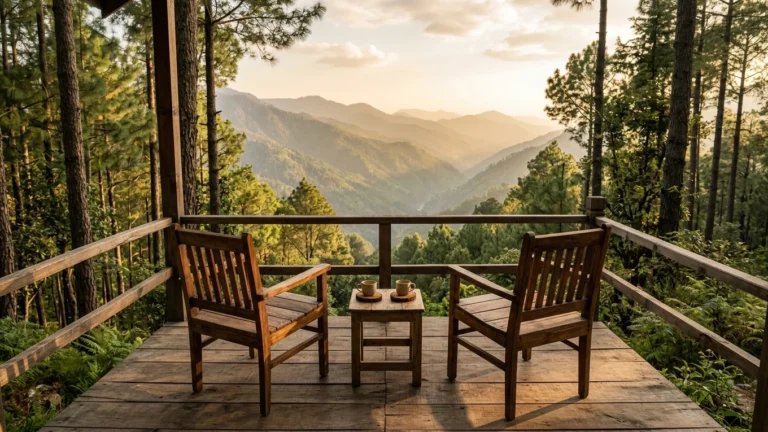
- Informal Sartorial & Physical Demarcation: Suits, structured attire, and polished office gear are discarded for hiking boots, fleece jackets, and comfortable outdoor layers. When everyone navigates gravel hill paths and sits on wooden veranda benches, traditional corporate veneer evaporates.
- Communal Dining & Campfire Unwinding: Unlike formal banquet halls where executives naturally cluster by seniority, rustic mountain retreats center dining around shared buffets, outdoor tea stations, and open evening fire pits. Under starlit Himalayan skies, conversation transitions naturally from guarded operational updates to genuine personal reflections.
- Shared Physical Vulnerability: Whether traversing a gentle deodar ridge trail together or navigating Class III rapids on the upper Ganges, physical challenge acts as a social equalizer. Seeing a C-suite executive encounter the same rough terrain or river spray fosters authentic empathy and mutual trust across organizational ranks.
This breakdown of artificial social distance is directly responsible for unlocking what organizational theorist Amy Edmondson defines as psychological safety—the shared belief that the team is safe for interpersonal risk-taking. In a secluded mountain setting, team members feel fundamentally empowered to voice dissenting perspectives, admit operational vulnerabilities, and commit fully to shared strategic mandates.
4. Three Distinct North Indian Offsite Archetypes (Ridge, River & Rapid Corridors)
Corporate offsite requirements vary dramatically depending on the cohort’s size, organizational seniority, and primary objective. A high-stakes board retreat requires radical stillness and pristine acoustic isolation; a high-energy sales kickoff demands structured physical collaboration and celebratory momentum; a quarterly business review requires seamless highway transit and high-capacity conference halls.
Within the Upvan retreat portfolio, corporate planners can deploy three distinct regional archetypes across North India:
Archetype A: High-Altitude Ridge Sanctuaries (Kanatal & Chail)
Best Suited For: CXO Executive Boards, Founder Summits, Annual Operating Plan (AOP) Formulation, Deep-Thinking Strategy (8 to 35 participants).
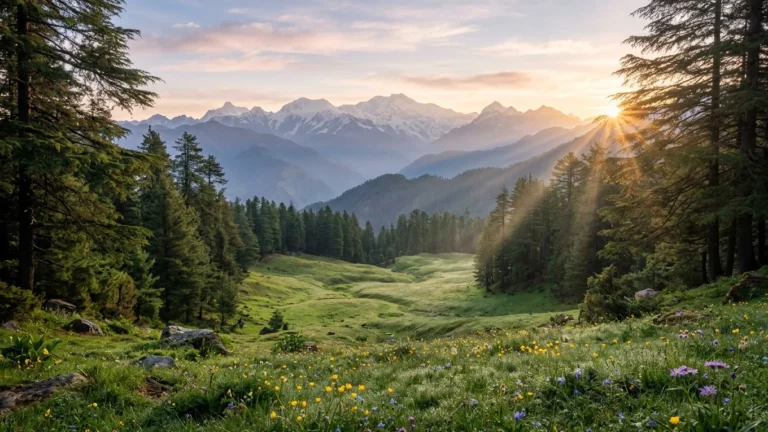
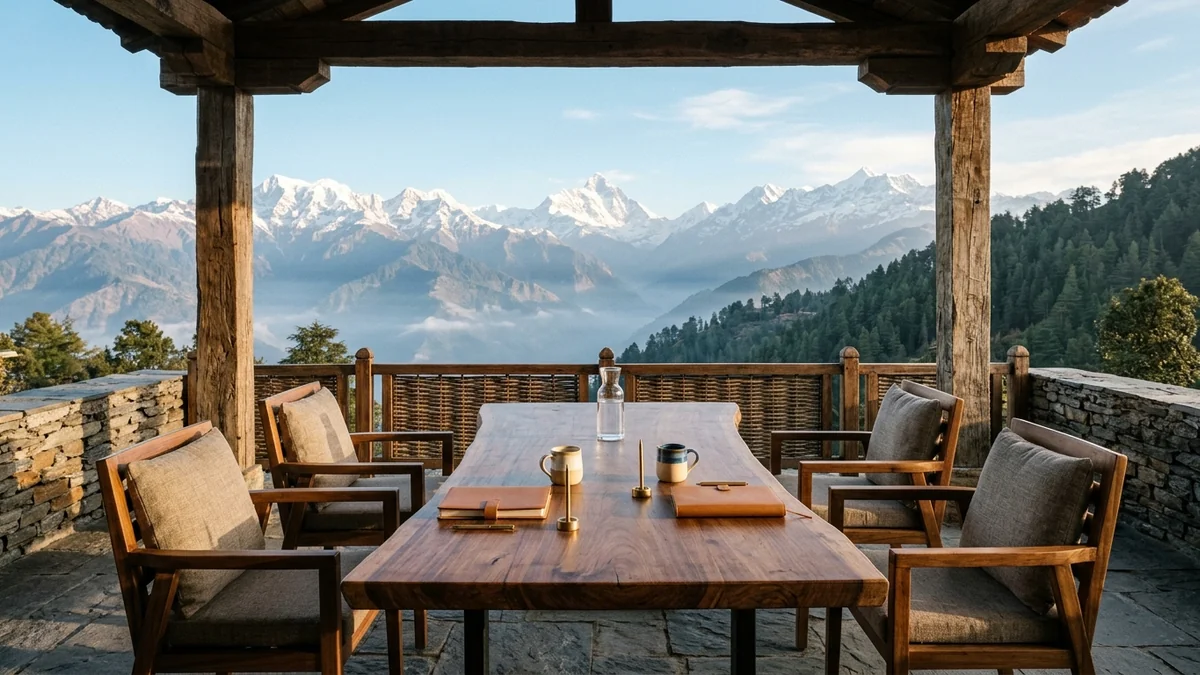
Perched at elevations between 2,100 and 2,600 meters, ridge destinations such as Kanatal and Chail offer crisp mountain air, cool summer temperatures (rarely exceeding 22°C in peak May–June), and sweeping panoramas of snow-crested Himalayan peaks. As explored in our destination analysis of Kanatal’s quiet high-altitude ridge escapes and the heritage pine trails detailed in our unhurried guide to Chail’s pine forest trails and heritage stays, these settings provide an atmosphere of total contemplative quietude. Executive teams conduct morning visioning workshops in sunlit wooden chalets or lawn gazebos, transitioning to afternoon ridge walks through quiet oak-and-deodar forests for one-on-one leadership alignment.
Archetype B: Foothill Adventure & Team Synergies (Rishikesh / Shivpuri)
Best Suited For: Cross-Functional Teams, Product Sprints, Sales Kickoffs, Milestone Celebrations (25 to 100+ participants).
Located at foothill altitudes (380–420 meters) where the Ganges emerges from deep Himalayan gorges, the Shivpuri and Byasi corridors blend structured indoor conferencing with invigorating outdoor team building. As detailed in our logistical breakdown of Rishikesh riverside camps versus hillside ridge retreats, dedicated adventure retreat venues—such as Rishikesh Camps—feature large covered conference halls, swimming pools, private banquet lawns, and direct coordination for UTDB-regulated white-water rafting expeditions and team obstacle courses. The combination of intense morning workshops followed by a shared descent down turbulent Himalayan rapids builds unparalleled collective grit and cross-departmental trust.
Archetype C: Rapid-Turnaround Highway Retreats (Near Delhi / Aravalis)
Best Suited For: Town Halls, Quarterly Business Reviews (QBRs), Large Corporate Summits (30 to 150+ participants).
When business timelines dictate an intensive 24-to-48-hour program without the travel time required for an ascent into Himachal or Garhwal, accessible luxury resort corridors along NH 8 and the Aravali foothills (such as curated corporate offsites near Delhi) provide an optimal solution. Situated under 60 minutes from Gurgaon and South Delhi, these properties feature multiple air-conditioned conference halls, state-of-the-art audiovisual setups, extensive banquet lawns, and ample on-site coach parking. Teams maximize operational productivity by eliminating transit downtime while still enjoying resort seclusion away from metropolitan office towers.
5. Side-by-Side Offsite Archetype Comparison Matrix
The table below evaluates key operational parameters across the three primary retreat archetypes to assist corporate organizers in matching venue characteristics with business objectives:
| Planning Parameter | Ridge Sanctuaries (Kanatal/Chail) | Foothill Adventure (Rishikesh/Shivpuri) | Near-Delhi Corridors (Aravalis/NH8) |
|---|---|---|---|
| Primary Objective | Leadership alignment, AOP, strategic deep work | Team building, sales kickoffs, milestone celebration | QBRs, quick town halls, operational reviews |
| Optimal Group Size | 8 to 35 participants | 25 to 100+ participants | 30 to 150+ participants |
| Transit Time from Delhi | 7.0 to 8.5 hours (Road) / Shatabdi to Kalka/Dehradun | 4.5 to 5.5 hours (Delhi-Meerut Expressway / NH334) | 45 to 75 minutes (Direct highway drive) |
| Recommended Duration | 3 Nights / 4 Days | 2 Nights / 3 Days | 1 Night / 2 Days or Day Summit |
| Meeting Spaces | Intimate wooden chalets, open lawns, panoramic gazebos | Covered all-weather halls (50–120 pax), poolside decks | Large ballroom setups, divisible breakout rooms |
| Signature Experiential Component | Guided forest walks, sunset ridge discussions, stargazing | Ganges white-water rafting, ropes course, campfire DJ | Banqueting lawns, sports amenities, pool competitions |
| Climate Dynamics | Crisp mountain cool (12°C–22°C in summer/autumn) | Warm afternoons, cool canyon evenings; seasonal monsoon closure | Plains weather; fully climate-controlled air-conditioning |
6. Designing the Dual-Track Itinerary: Balancing Deep Work with Shared Vulnerability
The most frequent architectural failure of corporate offsites is agenda cramming. Organizers often treat offsites as extended office days, loading schedules with unbroken eight-hour slide decks, panel reviews, and formal speeches. In a mountain setting, this approach wastes the primary environmental asset: the restorative capacity of the natural terrain.
High-impact retreats operate on a Dual-Track Framework (60/40 Rule): 60% structured strategic focus paired with 40% shared experiential unburdening.
The 3-Day Mountain Executive Architecture
- Track 1: Morning Deep-Dive Strategy (08:30 – 13:00): Capitalize on post-sleep cognitive clarity. With mobile phones placed in intentional holding bays, conduct rigorous, multi-hour strategy blocks—AOP alignment, competitive threat matrices, or architectural roadmap reviews.
- Midday Nutrient Reset (13:00 – 14:30): Serve wholesome, nutrient-dense buffets prioritizing clean local proteins, seasonal vegetables, and light soups. Heavy, oil-laden banquets cause post-lunch lethargy, destroying afternoon mental acuity.
- Track 2: Experiential Immersion & Physical Problem-Solving (15:00 – 18:30): Shift focus away from screens. In high-altitude ridge stays, assign pairs to walk pine forest trails for 90-minute structured peer check-ins. In riverside settings, deploy cross-functional teams onto rafting sections where coordinating paddle strokes through Class III rapids demands absolute real-time presence.
- Track 3: The Evening Campfire Debrief (19:30 – 22:00): Transition into informal debriefs around an outdoor fire pit. The warmth of a wood fire and open mountain air softens formal communication barriers, allowing team members to unpack the day’s learnings and cement personal bonds without corporate pretense.
By systematically interleaving intense cognitive effort with outdoor physical exertion, participants avoid mental saturation. Insights formulated during morning sessions have time to incubate during afternoon nature walks, resulting in markedly superior strategic decisions by the retreat’s conclusion.
7. Technical & Operational Logistics: Bandwidth, Power Redundancy & AV Staging
While natural isolation is the primary strategic benefit of a mountain offsite, operational failure in technical infrastructure instantly compromises event success. Corporate organizers must verify three non-negotiable operational requirements:
A. Connectivity Architecture: Managed Access vs. Digital Detox
Avoid the misconception that mountain retreats have zero connectivity. Most established retreats across Rishikesh, Chail, and Kanatal maintain reliable high-speed broadband and 4G coverage in core conference spaces and main reception hubs. However, planners should deliberately communicate connection boundaries: ensure dependable Wi-Fi is available during formal presentation blocks, while encouraging teams to embrace natural blind spots along outdoor trails as purposeful digital detox zones.
B. Power Redundancy & Generator Backup
Rural mountain distribution grids are vulnerable to sudden localized power interruptions, especially during seasonal weather shifts. A vetted corporate retreat property must feature dedicated, on-site diesel generator (DG) backup with automatic mains failure (AMF) panels. This ensures that projectors, audio mixers, lighting, laptop charging banks, and climate-control systems experience zero operational downtime during executive presentations.
C. Acoustics & Climate-Controlled Breakout Spaces
Outdoor lawn sessions are idyllic for informal breakouts, but intensive strategic presentations require controlled indoor acoustics. Verify that your chosen venue provides a covered, weather-sealed meeting hall equipped with high-lumen projectors, wireless collar microphones, and adequate acoustic damping to prevent sound reverberation.
8. Ground Transportation, Coach Accessibility & Mountain Convoy Safety
Moving a corporate cohort of 20 to 80 people across mountain roads requires meticulous transport coordination. A critical logistical error made by inexperienced planners is chartering large 45-seater luxury intercity coaches for the entire journey.
While multi-axle luxury coaches operate smoothly on the plains of NH 44 or the Delhi-Meerut Expressway, their long wheelbases and wide turning radiuses make them unsuitable—and frequently legally prohibited—on narrow, winding single-lane Himalayan mountain ascents (such as the upper loops from Kandaghat to Chail or the steep descent spurs in Byasi).
Recommended Transit Architecture
For cohorts larger than 25 participants traveling to high-altitude ridge destinations, the optimal logistics model involves high-speed rail or luxury coach transit to the foothill railheads (such as Kalka or Haridwar/Rishikesh), where the group transfers into a convoy of 12-to-17-seater Force Urbania or Tempo Traveller vehicles. As highlighted in our operational manual on Himalayan mountain driving protocols, smaller mountain-rated vehicles navigate sharp hairpins comfortably, maneuver safely around oncoming traffic, and negotiate steep property access ramps without delay.
Additionally, corporate organizers should schedule structured rest stops along established expressway food plazas (such as Cheetal Grand along NH 334 or Murthal/Karnal hubs on NH 44) to keep the convoy unified and allow participants to stretch before ascending mountain switchbacks. For detailed travel corridors within comfortable driving thresholds, explore our curated guide to scenic mountain routes from Delhi under seven hours.
9. The Corporate Planner’s Pre-Booking Verification Checklist
Before executing service agreements or releasing retreat deposits, corporate administrative leads should cross-examine prospective retreat venues against these five essential operational parameters:
- Dedicated Indoor Meeting Space Capacity: Verify that the primary conference hall comfortably accommodates your total headcount in cluster or theater seating, with adequate floor space for projector throw distances and breakout discussion tables.
- Power Backup & Continuous Fuel Supply: Request confirmation that the on-site generator supports the entire conference load (AV equipment, lighting, and climate control) with sufficient fuel reserves for 24 hours of continuous operation.
- Dietary Customization & All-Day Beverage Stations: Ensure the culinary team can accommodate diverse dietary preferences (vegetarian, vegan, Jain, gluten-free) and maintain continuous tea, coffee, and water hydration stations throughout work sessions.
- Transparent GST Invoicing & Commercial Governance: Confirm that the retreat provider issues compliant GST tax invoices covering lodging, dining, conferencing, and transport services under clear corporate billing heads.
- Advance Lead-Time Window: Corporate retreats requiring exclusive room blocks, multi-vehicle logistics, and private meeting facilities should be finalized three to four weeks in advance, particularly during peak autumn (October–November) and spring (March–April) business travel windows.
Plan Your Tailored Mountain Corporate Retreat
Upvan Hotels & Resorts curates bespoke corporate retreats, executive offsites, and team-building expeditions across North India. From intimate board summits in the quiet cedar forests of Chail and Kanatal to high-energy team adventures along the Ganges in Rishikesh, our dedicated corporate concierge coordinates handpicked stays, covered conference staging, transparent GST billing, and ground logistics.
Plan Your Mountain Retreat with Upvan
Experience handpicked mountain resorts, pine-sheltered cottages, and riverside sanctuaries across Himachal Pradesh, Uttarakhand, and near Delhi NCR. Enjoy verified hospitality, best direct rates, and personalized mountain itineraries.