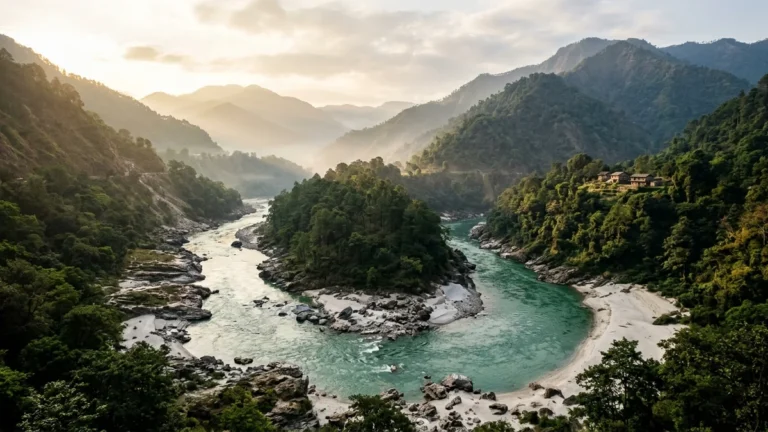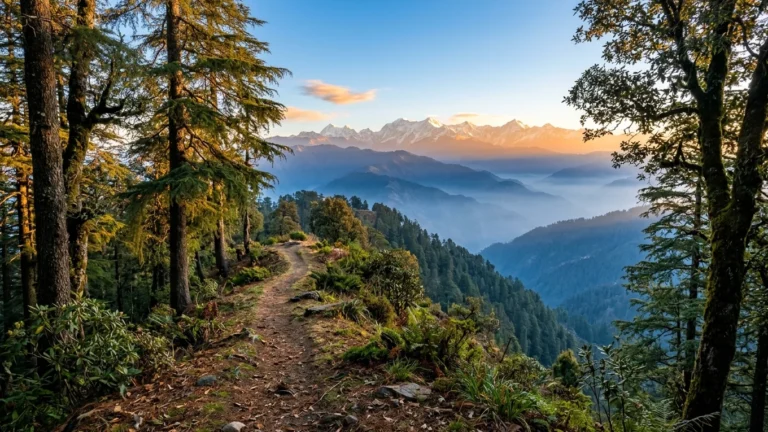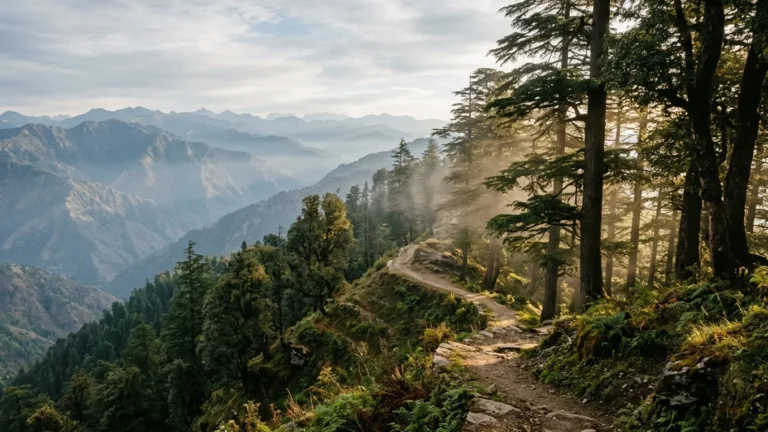
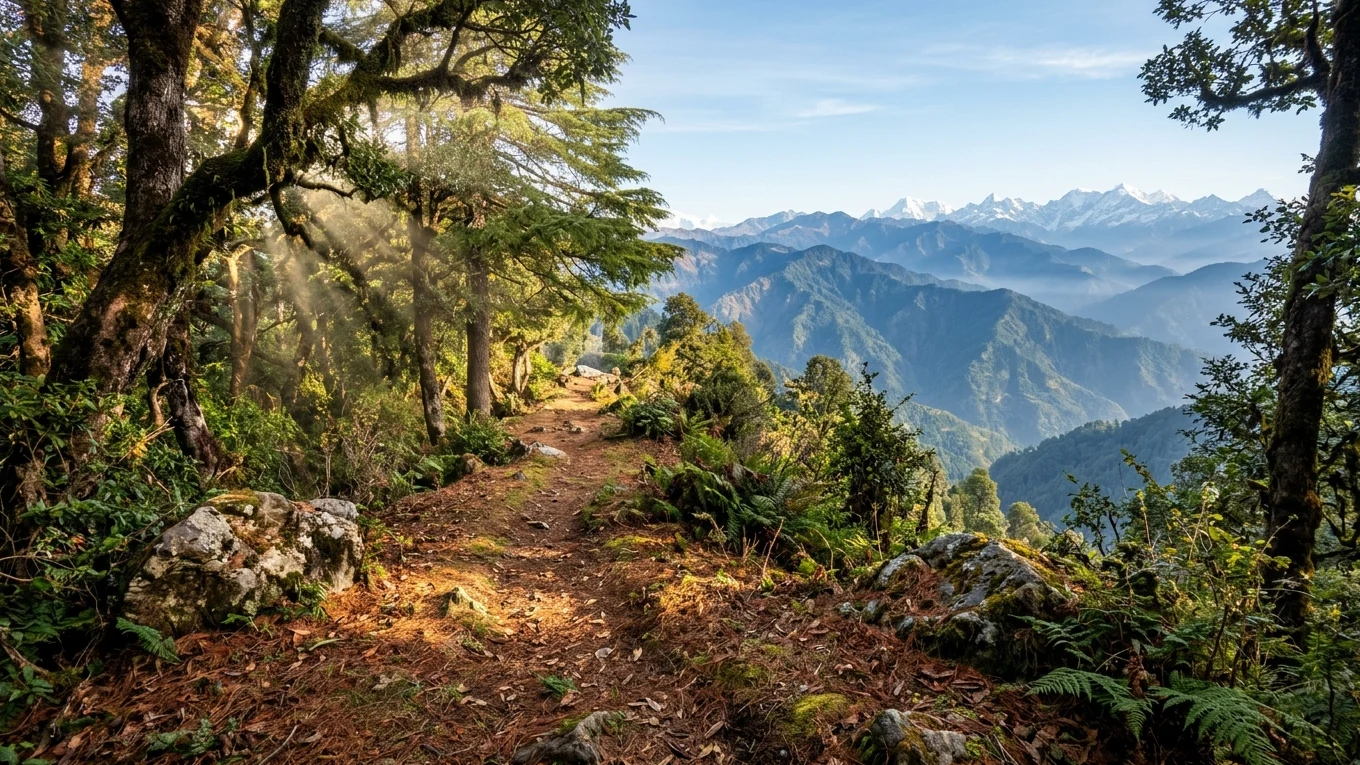
Nainital Outskirts at a Glance: While central Nainital centers around Naini Lake (2,084 m) and its bustling Mall Road—where evening vehicle bans (6:00 PM to 10:00 PM during peak season), strict one-way traffic, and scarce parking can cause frustrating delays—the peaceful outer ridges of the Kumaon hills offer a completely different Himalayan experience. Just 13 to 15 kilometres northwest, the quiet hamlet of Pangot (1,950–2,100 m) and the adjacent Kilbury Forest Reserve (2,528 m) shelter dense ban oak and cypress canopies supporting over 250 to 500 recorded bird species, including Cheer, Koklass, and Kalij pheasants. Nearby, Naina Peak (Cheena Peak, 2,615 m) provides panoramic vistas of Nanda Devi and Trishul via an unhurried 6 km forested walking trail. For travellers departing Delhi NCR, basing yourself along the outer hillside perimeter or Pangot approach allows you to bypass town-centre vehicular bottlenecks entirely, enjoy dedicated on-site parking, and immerse yourself in serene mountain silence.
For more than a century and a half, Nainital has held an enduring place in the travel imagination of northern India. Clustered tightly around the emerald waters of its eye-shaped natural lake at 2,084 metres above sea level, the town grew during the colonial era as an administrative summer refuge and later flourished as one of Uttarakhand’s most celebrated hill stations. Yet for modern travellers arriving from Delhi NCR and the northern plains, the quintessential image of quiet mountain solace often collides with modern urban congestion. In peak summer months and long autumn holiday weekends, the narrow lakeshore corridor can experience gridlock, municipal parking lots reach capacity before midday, and vehicle restrictions transform simple journeys into logistical puzzles.
What many visitors never realize, however, is that the true natural soul of Nainital does not reside on the crowded pavements of the Mall Road. It lives on the high, wind-swept ridgelines and secluded forest corridors that encircle the town’s perimeter basin. Just minutes beyond the urban periphery, the noise of honking taxis and boat horns fades into the deep rustle of Himalayan chir pines (*Pinus roxburghii*), the dense mossy boughs of ban oak (*Quercus leucotrichophora*), and the clear calling of mountain thrushes. From the avian sanctuary of Pangot and the high canopy of Kilbury to the windswept summit of Naina Peak, exploring Nainital’s outskirts reveals a serene, unhurried mountain sanctuary that feels worlds apart from the busy lake below.
Whether you are planning a tranquil weekend retreat, looking for peaceful curated destinations in Nainital, or seeking a quiet base for nature walks and bird photography, this comprehensive guide explains how to experience the best of Nainital’s outskirts without the stress of town-centre congestion.
The Central Basin vs. The Outer Ridges: Understanding Nainital’s Topography
To plan an effortless journey to Nainital, one must first understand its unique physical geography. The town sits inside a steep-sided tectonic depression in the Kumaon Lesser Himalayas, formed along the active Nainital Fault. At the bottom of this bowl-shaped valley rests Naini Lake, measuring approximately 1.4 kilometres in length and bordered on both sides by narrow strips of commercial and residential land. This natural geography creates a funnel effect: all town life, vehicular movement, hotels, and tourist attractions are compressed into the basin floor.
This physical constriction has led the local administration and Nainital Traffic Police to implement strict vehicular controls to maintain public safety and traffic flow:
- Mall Road Evening LMV Ban: During peak tourist seasons (May, June, October) and designated holiday weekends, light motor vehicles (LMVs) and private tourist cars are strictly prohibited on the Mall Road between 6:00 PM and 10:00 PM. Only emergency services and authorized administration vehicles are permitted.
- Strict One-Way Circulation: Vehicles entering from the plains via Kathgodam reach Tallital (the lower end of the lake). Traffic directed toward Mallital (the upper end) must adhere to strict one-way corridors, meaning that missing a turn requires looping back through town chokepoints.
- Severe Parking Bottlenecks: Designated parking spaces in central Nainital—principally the Flatts ground at Mallital and the Sukhatal parking facility—fill rapidly on busy mornings. Once these lots reach saturation, private vehicles are frequently intercepted at outer satellite holding areas (such as the Russi bypass or Narayan Nagar) and directed to wait until inner bays clear.
By contrast, the outer ridges surrounding the central basin rise several hundred metres higher, ranging from 2,100 to over 2,600 metres. These outer ridges—spanning Sukhatal’s upper slopes, the Pangot saddle, Kilbury Forest, and the Ayarpatta crest—are characterized by expansive forest reserves, sparse human settlement, open hillside valleys, and unbroken horizons. By choosing to stay along these outskirts, travellers bypass the daily stress of town-centre parking, enjoy seamless vehicle access to their accommodations, and wake up to pristine mountain air rather than morning traffic queues.
Pangot and Kilbury: Oak Canopies and Avian Corridors
Situated approximately 13 to 15 kilometres northwest of Mallital, the small mountain hamlet of Pangot and the adjoining Kilbury Forest Reserve represent one of the finest temperate bird sanctuaries in the Western Himalayas. Reached via a scenic, winding mountain road that climbs steadily above the Nainital valley, this forested corridor feels like a step back into an earlier, untouched era of Kumaon.
| Feature | Central Nainital (Mall Road / Basin) | Outskirts: Pangot & Kilbury Belt |
|---|---|---|
| Elevation | 2,084 metres (6,837 feet) | 1,950 – 2,528 metres (6,400 – 8,294 feet) |
| Atmosphere & Ambience | Vibrant, commercial, bustling, crowded streets | Serene, contemplative, quiet forest canopy |
| Vehicular Movement | Heavy traffic; evening bans (6–10 PM); one-way rules | Light rural mountain road; unrestricted movement |
| Parking Accessibility | Severe shortages; lots fill early; satellite diversions | On-site private parking at hillside retreats and cottages |
| Himalayan Snow Views | Obscured by surrounding valley ridges | Sweeping vistas of Trishul, Nanda Devi, and Panchachuli |
| Flora & Fauna | Ornamental town trees; urban pigeons and waterfowl | Dense ban oak, cypress, deodar; 250–500 bird species |
| Recommended For | Short boat rides, souvenir shopping, street cafes | Nature lovers, hikers, families, birdwatchers, quiet retreats |
The Avian Wealth of Kilbury
The Kilbury Forest Reserve sits at an elevation of approximately 2,528 metres within a contiguous belt of government reserve forest. The forest structure here is exceptional: ancient ban oak (*Quercus leucotrichophora*), kharsu oak (*Quercus semecarpifolia*), Himalayan cypress (*Cupressus torulosa*), and wild rhododendron trees form a layered, moisture-rich canopy draped in hanging lichen and moss. This microclimate provides an abundance of seeds, berries, and insects, making it a critical haven for avian life.
Ornithological records and wildlife surveys by institutions like the Wildlife Institute of India and local naturalists document between 250 and over 500 resident and migratory bird species across the Pangot-Kilbury-Sigri belt. Among the most prized sightings are:
- The Elusive Cheer Pheasant (*Catreus wallichii*): A globally vulnerable high-altitude pheasant that inhabits steep, grassy, rocky ravines around Pangot and Sigri. Spotting a pair foraging in the early morning mist is a bucket-list event for bird enthusiasts across Asia.
- Koklass Pheasant (*Pucrasia macrolopha*) & Kalij Pheasant (*Lophura leucomelanos*): Regularly seen darting across quiet forest dirt tracks or scratching among damp leaf litter on the shaded northern slopes.
- Raptors & Scavengers: The thermals rising along the Kilbury ridge attract majestic raptors, including the Lammergeier (Bearded Vulture), Himalayan Griffon, Steppe Eagle, and Mountain Hawk-Eagle soaring effortlessly against the blue sky.
- Canopy Songbirds & Woodpeckers: Rufous-bellied Woodpecker, Greater Yellow-naped Woodpecker, Blue-winged Minla, Red-billed Blue Magpie, Spotted Forktail, and a dazzling array of laughingthrushes, flycatchers, and warblers that fill the morning air with intricate melodies.
For visitors, exploring Kilbury requires no technical climbing. Walking quietly along the tarmac road or taking gentle forest fire-trails in early morning hours (between 06:00 and 09:30 AM) with a pair of 8×42 binoculars offers hours of absorbing observation without encountering a single tourist tour bus.
Naina Peak (Cheena Peak): The Sovereign Viewpoint of Kumaon
Rising commandingly to an elevation of 2,615 metres (8,579 feet) directly north of the town basin, Naina Peak—historically documented as Cheena Peak—is the highest geographical point encircling Nainital. While many tourists take the mechanized ropeway to the crowded viewpoint at Snow View, Naina Peak preserves an authentic walking tradition that rewards patient travellers with one of the most magnificent panoramic views in Uttarakhand.
The Trail and Ascent
The trail to Naina Peak begins near Sukhatal or Mallital (near the staff quarters / Birla Vidyamandir approach). Spanning approximately 6 kilometres each way, the route winds steadily upward through tranquil groves of cypress, deodar cedar, and dense oak forest. The path is well-defined and accessible to anyone with reasonable walking fitness, rising approximately 530 metres in vertical elevation over the course of the walk.
As you ascend, the ambient sounds of the town dissolve entirely. The forest floor is soft with accumulated pine needles and fallen oak leaves. In spring (March and April), wild rhododendron trees burst into vibrant scarlet and pink blossoms, dusting the trail in petals. In autumn, the air is crisp, cool, and crystalline, with sunlight slanting dramatically through the tall tree trunks.
The Summit Panorama
Reaching the crest of Naina Peak reveals a breathtaking dual panorama. Looking south, the entire Naini Lake basin unfolds below in miniature, its emerald-green waters cradled within the surrounding ridges. But turning northward provides the true climax of the journey: an uninterrupted, 360-degree vista of the Great Himalayan range stretching across hundreds of kilometres of the horizon.
On clear mornings—especially during the golden autumn months celebrated in our guide to autumn Himalayan panoramas—the snow-dusted massifs of Nanda Devi (7,816 m, India’s second-highest summit), the three-pronged trident of Trishul (7,120 m), Nanda Kot (6,861 m), and the Panchachuli peaks stand sharp against the azure sky. Carrying a light thermos of hot tea and arriving at the summit by 08:30 AM allows you to witness the morning sun illuminating the eternal snowfields before thermal clouds begin gathering in the afternoon.
Tiffin Top and the Ayarpatta Ridge: Shaded Walks and Heritage Trails
On the opposite, southern rim of the Nainital basin lies the Ayarpatta hill and Dorothy’s Seat, popularly known as Tiffin Top. Situated at an elevation of 2,292 metres (7,520 feet), this promontory is named after Dorothy Kellett, an English artist whose husband constructed a stone memorial bench on the ridge after her passing.
While the central viewpoint can attract afternoon pony-riding groups on weekends, the surrounding forest trails through Ayarpatta offer some of the most serene walking corridors in the district. The slopes of Ayarpatta are densely cloaked in native ban oak and tall deodar trees, which create a cool, moist understory where ferns and mosses flourish. Walking along the outer carriage roads—laid out during the late nineteenth century with gentle, graded inclines—provides gentle strolls suitable for multi-generational families and travellers who prefer unhurried wandering over steep mountain climbs.
From Dorothy’s Seat, the view encompasses both the gentle green bowl of the Nainital basin and the rugged southern countryside that falls away toward the Tarai plains. Combining an early morning walk to Tiffin Top with a quiet picnic under the shade of ancient oaks captures the leisurely, restorative pace of classic Himalayan hill holidays.
Navigational Logistics: Reaching the Outskirts Without Town Gridlock
One of the greatest advantages of planning an outskirts-focused holiday is the ability to bypass the vehicular congestion that often plagues central Nainital. Understanding the approach corridors from Delhi NCR and the foothill railheads ensures your journey remains relaxed from door to door.
The Driving Corridor from Delhi NCR
The total driving distance from Delhi NCR to Nainital is approximately 290 to 310 kilometres, depending on your starting point in Noida, Delhi, or Gurugram. The recommended route follows high-speed expressways and national highways across the western Uttar Pradesh plains before beginning the mountain climb:
- Delhi to Rampur via NE-3 and NH-9: Take the Delhi-Meerut Expressway (NE-3) past Dasna, then continue along National Highway 9 past Hapur, Garhmukteshwar, Moradabad bypass, and Rampur. This four- to six-lane corridor allows smooth cruising, covering approximately 190 km in 3 to 3.5 hours.
- Rampur to Kathgodam via Bilaspur, Rudrapur, and Haldwani: From Rampur, turn northward onto NH-109 through Bilaspur and Rudrapur, continuing into the commercial gateway of Haldwani and Kathgodam at the foot of the hills (approx. 70 km, 1.5 to 2 hours depending on town traffic).
- Kathgodam to Nainital / Sukhatal Ascent: From Kathgodam, the road climbs into the mountains via Jeolikote on NH-109 (approx. 35 km, 1 to 1.5 hours). The road is well-surfaced with gentle gradients and broad sweeping turns.
For those interested in exploring alternative classic routes in the region, our detailed Delhi to Chakrata road trip guide and Delhi to Chail driving route guide offer similar practical logistics for travellers exploring the lower Himalayas.
The Critical Navigation Tip: The Sukhatal Bypass
When arriving in the mountains with a booking on the outskirts (such as Pangot, Sigri, or the Sukhatal hillside approach), do not navigate down onto the lakeside Mall Road. During evening hours (especially 6:00 PM to 10:00 PM), tourist cars cannot transit the Mall Road, and daytime traffic moving from Tallital to Mallital can be slow.
Instead, follow the upper bypass road from Tallital that traverses above the lake basin toward Sukhatal and the Kilbury-Pangot road. By taking this route, you skirt the congested town core entirely, arriving directly at your hillside accommodation without entering the Mall Road traffic bottleneck.
Mountain Driving Safety on Kumaon Roads
While the roads leading to Nainital and Pangot are generally well-maintained tarmac, the hill sector requires disciplined mountain driving techniques:
- Use Engine Braking on Descents: When descending steep grades, downshift to a lower gear (second or third gear in manuals; low or sequential mode in automatics) to engage drivetrain resistance. Over-relying on the foot brake leads to friction pad overheating, brake fluid boiling, and dangerous brake fade. Review our authoritative mountain driving safety protocols for a deep technical breakdown of brake hydraulics and gradient control.
- Hill Etiquette & Uphill Precedence: Under Regulation 21 of the Motor Vehicles (Driving) Regulations, 2017, where a mountain road is too narrow for vehicles to pass freely, the driver descending the hill must pull aside and give precedence to ascending vehicles, as starting an uphill vehicle on a steep gradient requires significant clutch and engine effort.
- Drive in Daylight: Always plan your itinerary to complete the mountain ascent during daylight hours. Night driving in the hills involves reduced visibility, mountain mist, and unlit village livestock.
Seasonal Rhythms: When to Experience the Outer Ridges
Unlike the town centre, which remains oriented around shopping and lake boating throughout the year, the outer pine ridges and oak sanctuaries of Nainital respond intimately to the changing Himalayan seasons.
1. Spring (March to April): The Rhododendron Awakening
Spring is arguably the most vibrant season on the outskirts. The scarlet blossoms of the native *Buransh* (rhododendron) illuminate the dark green oak canopies with splashes of vivid crimson. Temperatures range between a comfortable 12°C and 22°C. Resident songbirds begin establishing breeding territories, filling the morning air with song. This is an ideal window for leisure walking, nature photography, and family escapes before the intense summer heat hits the plains.
2. Summer (May to June): The Cool Forest Refuge
While central Nainital experiences peak crowds, packed streets, and midday traffic jams during May and June, the outer ridges at Pangot (1,950 m) and Kilbury (2,528 m) remain refreshingly cool. Shaded by dense oak and pine foliage, daytime temperatures hover between 15°C and 25°C, dropping to a crisp 12°C at night. Staying outside the town basin allows travellers to enjoy cool mountain breezes and peaceful surroundings while avoiding the urban stress of the busy season.
3. Autumn (October to November): Crystalline Horizons and Snow Peaks
Following the withdrawal of the monsoon in late September, the atmosphere is thoroughly cleansed of suspended dust and moisture haze. October and November provide the highest frequency of cloud-free days of the year. The Great Himalayan peaks—Nanda Devi, Trishul, and Panchachuli—appear razor-sharp across the northern horizon. The forests turn amber and gold, and daytime temperatures (10°C to 18°C) are perfect for brisk ridge walks to Naina Peak.
4. Winter (December to February): Fireside Solitude and Frosty Pines
Winter brings profound quiet to the outskirts. While central Nainital sees occasional weekend crowds, the ridges around Pangot and Kilbury experience true Himalayan serenity. Nights are cold (dropping between -2°C and 4°C), and frosty mornings paint the pine needles with delicate ice crystals. Occasional snowfall blankets the higher slopes of Naina Peak and Kilbury in mid-winter. For travellers seeking fireside warmth, private balconies overlooking quiet valleys, and unhurried contemplation, winter on the outskirts is unmatched.
Family Travel on the Outskirts: Space, Safety, and Nature
For families travelling with children or elder family members, the central town basin can present significant physical challenges. Navigating steep, congested staircases between the Mall Road and hillside hotels, dodging constant two-wheeler traffic, and waiting in crowded parking queues can quickly exhaust both young and old.
Choosing an outskirts-based retreat fundamentally transforms the family holiday experience. As detailed in our comprehensive guide to planning memorable family holidays in the hills, successful multi-generational travel requires three essentials: dedicated on-site parking, safe and open outdoor spaces, and quiet, walkable surroundings. Hillside cottages and nature retreats along the outer perimeter provide open grassy lawns where children can run freely without vehicular danger, level garden sitting areas for grandparents to enjoy morning tea, and gentle walking paths directly accessible from the property gates.
Lodging Strategy: Hillside Cottages and Curated Nature Retreats
Where you choose to sleep dictates the character of your entire Nainital holiday. Staying in town-centre hotels often means accepting cramped rooms, noise from nearby bars and traffic, difficult parking maneuvers, and long walks up steep alleys carrying luggage.
By contrast, selecting a nature-focused hillside cottage along the outer perimeter or Pangot approach offers several distinct advantages:
- Guaranteed Dedicated On-Site Parking: You drive straight to your accommodation, park your vehicle securely within the property grounds, and never have to worry about finding an empty municipal parking slot or facing outer satellite holding areas.
- Private Balconies and Valley Panoramas: Instead of looking out at neighbouring concrete roofs or noisy street vendors, your room or cottage opens to wide, layered views of forested mountain ridges and sunrise valleys.
- Authentic Mountain Peace: The night air is filled only with the whispering of pine needles and the gentle calls of nightjars, providing deep, restorative sleep.
- Direct Trail Access: Forest walking trails, birdwatching viewpoints, and quiet village paths begin directly at your doorstep, allowing spontaneous morning explorations without needing to hire local transport.
Among the curated lodging options in this region, Nainital Camps & Cottages provides a peaceful retreat situated on the scenic outer hillside perimeter along the Pangot approach. Offering dedicated on-site parking, spacious hillside accommodations, and open views across the quiet Kumaon ridges, it serves as an ideal base for discerning travellers who want the scenic majesty of Nainital without its town-centre traffic. In accordance with Upvan’s transparent partner disclosure policy, Upvan coordinates and curates verified mountain stays with local partner hosts, ensuring rigorous quality and personalized service without claiming direct property ownership.
To explore additional destinations and handpicked retreats across Uttarakhand and Himachal Pradesh, visit our complete collection of curated mountain destinations.
Frequently Asked Questions (FAQ)
How far is Pangot from central Nainital, and how do you reach it?
Pangot is situated approximately 13 to 15 kilometres northwest of central Nainital (Mallital). By car or taxi, the scenic mountain drive takes between 35 and 45 minutes along the well-surfaced Kilbury road. The route climbs steadily past Sukhatal and through the Kilbury Forest Reserve before descending gently into the quiet Pangot valley. When driving from Kathgodam or Haldwani, you can take the upper bypass to Sukhatal, reaching the Pangot road without having to cross the congested lower Mall Road corridor.
Are vehicles allowed on Nainital’s Mall Road at all times?
No. To control traffic congestion and ensure pedestrian safety, the local administration restricts private vehicles and tourist cars on the Mall Road during designated peak hours. During peak tourist seasons (May, June, and October) and long holiday weekends, light motor vehicles (LMVs) are strictly prohibited on the Mall Road between 6:00 PM and 10:00 PM. Additionally, strict one-way traffic circulation applies throughout the day between Tallital and Mallital. Travellers staying on the outskirts or near Sukhatal can bypass these restrictions entirely by utilizing upper perimeter roads.
Which birds can you spot at Kilbury Bird Sanctuary?
Kilbury Forest Reserve and the surrounding Pangot-Sigri corridor are home to over 250 to 500 recorded bird species, making it one of the premier birding destinations in the Western Himalayas. Commonly spotted species include the Cheer Pheasant, Koklass Pheasant, Kalij Pheasant, Lammergeier (Bearded Vulture), Himalayan Griffon, Rufous-bellied Woodpecker, Greater Yellow-naped Woodpecker, Blue-winged Minla, Red-billed Blue Magpie, and White-throated Laughingthrush. The best birdwatching hours are early morning from 06:00 to 09:30 AM.
Can beginners and families hike to Naina Peak (Cheena Peak)?
Yes. The trail to Naina Peak covers approximately 6 kilometres each way from the Sukhatal/Mallital base, gaining around 530 metres in elevation. While it involves a steady uphill walk, the path is wide, well-trodden, and shaded throughout by dense oak, cypress, and rhododendron trees. Anyone with moderate walking fitness can complete the ascent in 2 to 2.5 hours. It is an excellent day hike for families with children aged 8 and above, provided you wear sturdy walking shoes, carry drinking water, and start early in the morning.
Where can travellers stay in Nainital to avoid Mall Road traffic and parking issues?
To avoid parking shortages and vehicular congestion, choose accommodations located on the outer ridges and perimeter approaches rather than the town basin. The hillside corridors along the Pangot road, the upper slopes of Sukhatal, and the outer Ayarpatta ridge offer peaceful retreats with dedicated on-site parking and private garden grounds. For example, staying at hillside retreats such as Nainital Camps & Cottages on the outer perimeter allows seamless vehicle access and quiet mountain surroundings while remaining within easy driving distance of day-trip viewpoints.
What is the best season to explore Nainital’s outer pine ridges?
While the outskirts can be visited year-round, the two most rewarding seasons are spring (March to April) and autumn (October to November). Spring brings mild temperatures and vibrant red rhododendron blossoms, alongside active bird breeding activity. Autumn offers exceptionally clear, post-monsoon skies, crisp morning air, and the sharpest, most expansive panoramic views of Himalayan peaks like Nanda Devi and Trishul. Summer (May–June) provides a cool escape from the plains, while winter (December–February) delivers serene solitude and occasional snowfall on high ridges.
Plan an Unhurried Mountain Escape to Nainital’s Outskirts
Bypass town traffic and discover the peaceful forested ridges of Kumaon. Whether you are looking for private hillside cottages with dedicated on-site parking, guided birdwatching walks in Kilbury, or customized travel itineraries across the Western Himalayas, our travel specialists are ready to curate your journey.
Plan Your Mountain Retreat with Upvan
Experience handpicked mountain resorts, pine-sheltered cottages, and riverside sanctuaries across Himachal Pradesh, Uttarakhand, and near Delhi NCR. Enjoy verified hospitality, best direct rates, and personalized mountain itineraries.