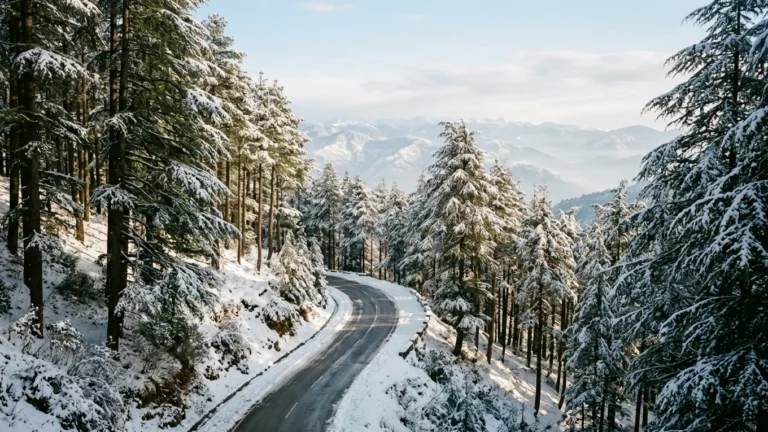
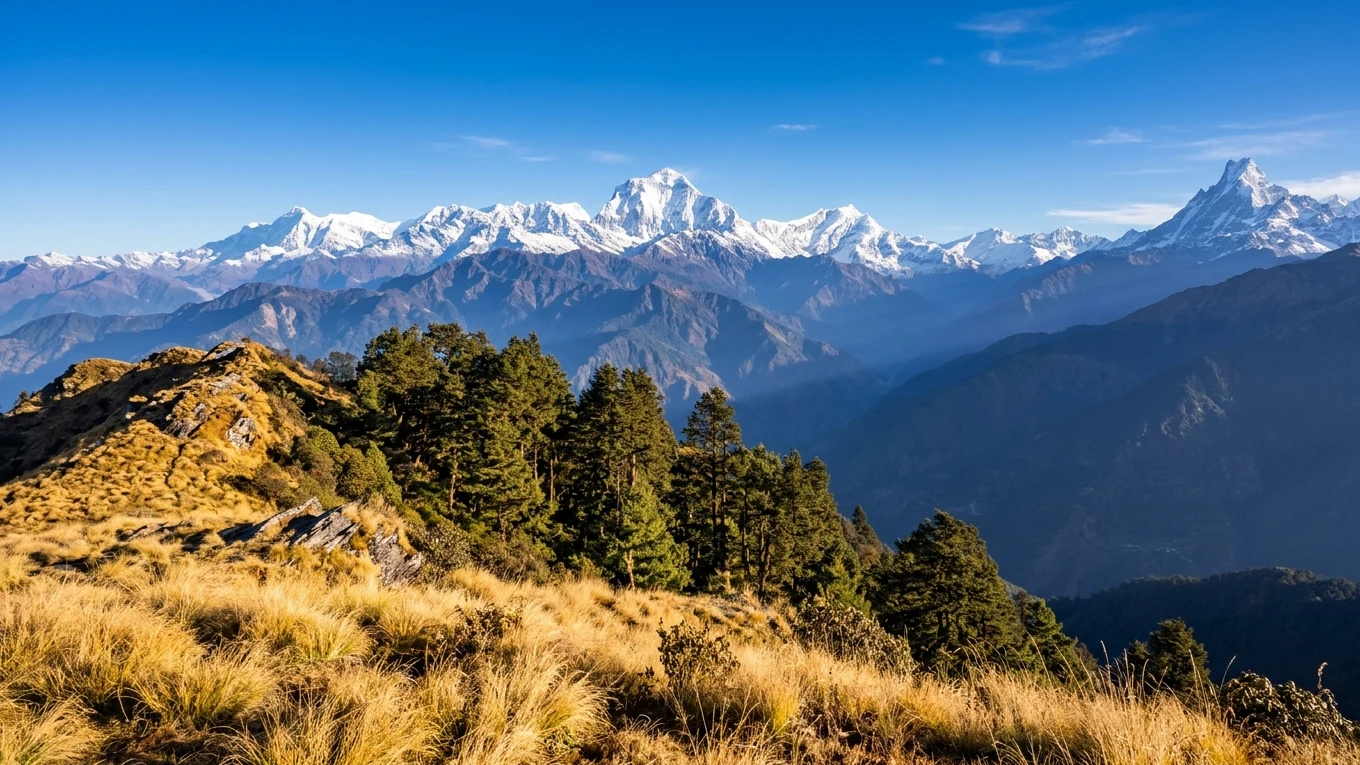
Autumn Himalayan Panoramas at a Glance: The post-monsoon months of October and November provide the most favorable atmospheric conditions of the year for viewing distant Himalayan snow peaks. Between June and late September, relentless monsoon rains scrub the troposphere clean of suspended mineral dust and aerosols through intense precipitation washout (wet scavenging). Following the monsoon trough’s withdrawal, relative humidity drops sharply from 90% down to 35–55%, and convective storm clouds dissipate into deep, cloudless skies before winter blizzards arrive in December. However, atmospheric clarity is not a blanket daily guarantee: late-autumn agricultural smoke can create haze in low valleys below 1,500 metres, meaning travelers must seek high-altitude ridgelines (2,000 to 2,600 metres)—such as Kanatal, Chail, or Chakrata—and plan panoramic viewing during crisp, unhurried early morning hours (06:00 to 09:30 AM).
Every year, as the Indian summer monsoon withdraws from the northern plains and the oppressive humidity of late September yields to cooler air, a profound transformation occurs across the Himalayas. For four months, dense monsoon clouds and mist have shrouded the higher ranges, restricting views to immediate valleys and waterlogged hillsides. Then, almost overnight, the skies break open. The air turns sharp and crystalline, the troposphere displays a deep azure hue, and distant snow-capped massifs—hidden for months—reappear along the northern horizon with breathtaking clarity.
For travellers researching curated mountain resorts near Delhi or scenic escapes across the Shivalik and Garhwal ridges, autumn represents an unparalleled travel window. Yet planning a journey centered on mountain vistas requires moving beyond generic seasonal folklore. Achieving expansive, horizon-wide panoramas is an exercise in atmospheric timing, altitude selection, and understanding local terrain dynamics. Understanding the meteorological mechanisms governing post-monsoon visibility ensures your mountain escape delivers genuine contemplation rather than disappointment.
The Atmospheric Science: Why Post-Monsoon Skies Turn Crystal Clear
The remarkable transparency of Himalayan skies during October and early November is neither accidental nor mystical; it is the direct consequence of three interrelated atmospheric phenomena documented by observational meteorologists across the Western Himalayas.
| Atmospheric Mechanism | Meteorological Process | Impact on Himalayan Visibility | Seasonal Window of Peak Effect |
|---|---|---|---|
| Tropospheric Wet Scavenging | Monsoon rains wash suspended particulate matter, dust, and aerosols out of the air column. | Aerosol Optical Depth (AOD) drops to its lowest annual baseline; minimal Mie light scattering. | Late September through late October. |
| Drastic Humidity Drop | Moist maritime air masses retreat southward, replaced by cool, dry continental air streams. | Relative humidity drops from 85–95% to 35–55%; atmospheric moisture haze and mist vanish. | Entire October–November corridor. |
| Convective Cloud Dissipation | Intense solar heating of moisture-rich soil ends; convective cloud thermals cease. | Absence of afternoon cumulonimbus towers; high frequency of sustained cloud-free days. | Mid-October through mid-November. |
| Pre-Winter Synoptic Calm | The quiet seasonal interlude before frequent mid-latitude Western Disturbances begin in winter. | Stable barometric pressure; minimal frontal storms, blizzards, or heavy cloud decks. | October through third week of November. |
1. Tropospheric Wet Scavenging (The Great Rain Washout)
Between late June and mid-September, the Southwest Monsoon deposits 75% to 80% of the entire annual precipitation across Himachal Pradesh and Uttarakhand. This relentless volume of rain performs an essential ecological and atmospheric service known as “wet scavenging.” Raindrops capture and drag down coarse airborne mineral dust, carbon particles, and suspended organic aerosols that accumulate during dry pre-monsoon summer months. By the time the monsoon trough completes its retreat in late September, the air column across the middle Himalayas has been thoroughly cleansed. Atmospheric scientists measuring columnar Aerosol Optical Depth (AOD) at Himalayan observatories consistently record annual lows during this post-monsoon transition.
2. The Plunge in Relative Humidity
High relative humidity causes microscopic water droplets to condense around fine aerosol particles, creating the milky, low-contrast haze typical of August and early September. With the arrival of dry, continental air streams from the northwest in October, ambient relative humidity plummets from saturated levels of 85–95% down to comfortable levels between 35% and 55%. Without water droplets to scatter light, Rayleigh scattering dominates, lending the autumn mountain sky its deep, ink-blue saturation and allowing the human eye to perceive snow crests located more than 120 kilometres away.
3. The Pre-Winter Synoptic Lull
Springtime in the mountains suffers from pre-monsoon dust transported from the arid Thar desert and seasonal forest fire smoke. Deep winter (December through February) brings aggressive Western Disturbances—extratropical weather systems that sweep in from the Mediterranean, cloaking ridges in heavy cloud decks, severe sleet, and blizzards. October and November occupy the golden middle ground: an atmospheric sweet spot of synoptic calm, low wind shear, and stable barometric pressure.
The Realities of Autumn Visibility: Inversion Layers and Valley Haze
While the atmosphere at high elevations is extraordinarily transparent in autumn, travelers must not confuse high-altitude clarity with a universal guarantee of clear views everywhere. Two critical geographic and human realities govern visibility during late October and November:
- The Thermal Inversion Barrier: As night temperatures drop sharply in late autumn, cold, dense air settles into low-lying plains and river valleys, trapping smoke and agricultural biomass burning emissions under a shallow “planetary boundary layer inversion.” Low-elevation valleys (below 1,500 metres)—such as the Doon Valley, Kalka, and river plains—can experience dense white-grey haze in November.
- The Ridge Elevation Advantage: High mountain ridges situated at or above 2,000 to 2,600 metres—such as Kanatal, Chail, and Chakrata—frequently sit *above* this nocturnal inversion layer. Travelers standing on these high spines look down upon a surreal “sea of clouds” or low-level haze trapped in the valleys below, while enjoying crystalline, unobstructed sightlines toward the snow peaks to the north.
- The Diurnal Valley Wind Effect: As the sun warms south-facing mountain slopes by midday, rising thermal currents (anabatic winds) can pump localized haze from lower valleys up toward the ridges. Consequently, mountain visibility follows a predictable diurnal curve: early mornings offer maximum clarity, while afternoons may see soft haze or localized cumulus clouds drifting along the summits.
Three Exemplary High-Altitude Ridges for Autumn Panoramas
To experience the finest panoramic vistas without enduring commercial city bottlenecks, select elevated destinations along broad ridge spines. Three quiet mountain sanctuaries within driving range of Delhi NCR stand out for autumn panorama travel:
| Destination & Ridge | Elevation & Position | Key Vantage Points | Major Snow Massifs Visible | Best Viewing Hours |
|---|---|---|---|---|
| Kanatal Ridge Tehri Garhwal, UK |
~2,590 m (8,500 ft spine) |
Surkanda Devi Temple ridge (~2,750 m), open cottage terraces. | Bandarpoonch (6,316 m), Swargarohini (6,252 m), Chaukhamba (7,138 m), Trisul (7,120 m). | 06:00 – 09:30 AM (Sunrise glow); 04:30 – 05:30 PM (Alpenglow). |
| Chail Pine Spines Solan District, HP |
~2,250 m (7,380 ft wooded ridge) |
Kali Tibba hilltop temple, Chail Palace upper lawns, Gaura trails. | Choor Chandni (Churdhar, 3,647 m), Greater Himalayan northern snowline, Shimla ridges. | 06:30 – 10:00 AM; 05:00 – 06:00 PM (Sunset over the plains). |
| Chakrata Highlands Dehradun District, UK |
~2,118 m (6,950 ft cantonment) |
Chilmiri Neck (open grassy plateau), Deoban ridge (~2,865 m). | Expansive 180° sweep of the Garhwal arc; Bandarpoonch and Swargarohini crests. | 06:15 – 09:45 AM; late afternoon before mountain dusk. |
1. Kanatal and the Surkanda Devi Spine, Uttarakhand
Perched along an elevated ridge at roughly 2,590 metres (8,500 feet), Kanatal offers one of the most direct, expansive viewing windows of the Garhwal Himalaya accessible by road from Delhi NCR. Looking north across the deep Bhilangna and Bhagirathi river valleys, the horizon is dominated by the majestic four-pillared massif of Chaukhamba (7,138 m), flanked by the sharp twin summits of Bandarpoonch (6,316 m) and the stepped ridges of Swargarohini.
The crown jewel of autumn viewing near Kanatal is the summit of Surkanda Devi Temple, situated at approximately 2,750 metres (9,020 feet). While historically requiring a strenuous pedestrian climb, the operational aerial ropeway allows travelers of all ages to glide smoothly to the summit in just five minutes. From the temple’s 360-degree viewing platform on a crisp October dawn, the Greater Himalayan arc glows in shades of molten gold before turning dazzling diamond-white against the azure sky.
For travelers planning an unhurried mountain stay directly facing these high peaks, Kanatal Camps & Cottages offers independent Swiss tents and stone cottages perched along the ridge, where sunrise over the snow peaks can be enjoyed from your private veranda.
2. Chail and Kali Tibba, Himachal Pradesh
While Chail is renowned primarily for its ancient deodar cedar forests and quiet royal heritage, its high topographical vantage points offer superb panoramic rewards in autumn. Unlike Shimla, where urban clutter and high-rise concrete obstruct open horizons, Chail’s wide wooded ridges remain tranquil and uncrowded. The premier panorama spot is Kali Tibba, a marble temple crowning the highest hillock in the area at roughly 2,250 metres.
Looking southeast from Kali Tibba across the deep valley, the solitary, monolithic dome of Choor Chandni (Churdhar Peak, 3,647 m) stands prominently against the autumn sky. To the north, on exceptionally clear October mornings, the glittering white crests of the Greater Himalayan ranges form an ethereal backdrop behind the tiered ridges of Kufri and Fagu. As evening approaches, Kali Tibba provides an unobstructed western vantage point, where the sun sets in blazing amber across the Shivalik foothills while the city lights of Chandigarh and Solan begin to twinkle thousands of feet below.
Those seeking curated walking routes through the surrounding cedar woods can explore our companion guide to unhurried walking trails in Chail, or discover comfortable lodging at Chail Camps & Cottages.
3. Chakrata and Chilmiri Neck, Uttarakhand
Tucked away in the Jaunsar-Bawar tribal belt, Chakrata is a tranquil, historic cantonment town surrounded by pristine deodar woodlands. For panoramic viewing, Chakrata’s standout feature is Chilmiri Neck—a vast, undulating plateau of open alpine grass situated at 2,160 metres, completely free from obscuring forest canopies or commercial infrastructure.
On clear October and November mornings, Chilmiri Neck reveals an unobstructed 180-degree vista of the snow-clad western Garhwal ranges, with the pyramidal peak of Bandarpoonch standing out in razor-sharp relief. Because Chilmiri Neck is a broad, flat grassy knoll, it allows photographers and travelers to set up tripods and relax in comfortable folding chairs without negotiating steep precipices. (Note: Because Chakrata remains an active military cantonment, travel regulations permit free entry to Indian nationals, while foreign nationals require prior military permission from the cantonment authorities).
To explore more secluded getaways within a manageable drive of the capital, consult our comprehensive guide to weekend mountain getaways under 7 hours from Delhi.
Autumn Panorama Trips vs. Winter Snowfall Trips: Choosing Your Season
Many travelers conflate autumn and winter travel in the hills, assuming that colder weather automatically delivers better mountain experiences. In reality, an autumn panorama journey and a winter snowfall journey serve fundamentally different travel intents. Choosing the right season depends entirely on whether your priority is expansive horizon views or tactile winter snow:
| Travel Dimension | Autumn Panorama Trip (October – November) | Winter Snowfall Trip (December – February) |
|---|---|---|
| Primary Visual Highlight | 100+ km horizon visibility; razor-sharp snow massifs against deep blue skies. | Local snowfall on pine branches, snow-covered roofs, and frozen ground. |
| Sky Condition | Predominantly clear, high solar radiation, cloud-free mornings. | Frequently overcast, thick storm clouds, grey skies during active fronts. |
| Road Conditions | Dry, post-monsoon repaired asphalt; predictable and safe hill driving. | Black ice, snow drifts, mandatory tyre chains, sudden road closures. |
| Outdoor Activities | Long forest trail walks, ridge picnics, unhurried landscape photography. | Cozy indoor fireside retreats, brief snow play, sub-zero limitations. |
| Daytime Temperatures | Pleasantly mild in the sun (15°C to 20°C); crisp, energizing mountain air. | Cold to sub-zero (0°C to 8°C); sharp windchill requiring heavy winter parkas. |
| Traveler Profile | Photographers, trekkers, nature lovers, multi-generational families. | Snow seekers, couples desiring cozy hearths, winter enthusiasts. |
If your goal is to stand on an open ridge and gaze at the mighty snow-capped peaks of the Greater Himalaya under brilliant sunshine, autumn is vastly superior to winter. During mid-winter, active storm systems frequently obscure the distant peaks behind thick cloud banks for days at a time. For those who specifically desire sub-zero winter snow and fireside retreats, our dedicated guide to winter snowfall travel in Chail details seasonal snow cycles and winter vehicle preparation.
The Diurnal Photography Rhythm: Mastering Sunrise, Noon, and Alpenglow
Photographing and appreciating Himalayan panoramas requires syncing your daily schedule with the sun’s trajectory and atmospheric thermal cycles. In autumn, light conditions vary dramatically across a twelve-hour window:
| Time Window | Lighting Character & Visibility | Optimal Activity for Travelers |
|---|---|---|
| 05:45 – 06:45 AM Civil Dawn to Sunrise |
Pre-dawn pink and purple hue on snow peaks, followed by golden morning light striking high summits. Atmospheric clarity is at its absolute maximum. | Position yourself on an east-facing high ridge with hot tea and a tripod. Capture the first golden light on Chaukhamba or Bandarpoonch. |
| 07:00 – 10:00 AM Morning Golden Hours |
Crisp, deep blue skies with high contrast; valley inversions appear as white clouds below the ridge. | Ideal window for panoramic ridge walks, forest nature trails, and wide-angle photography. |
| 11:30 AM – 03:00 PM Midday Solar High |
Harsh vertical sunlight washes out contrast on snowfields; thermal updrafts begin lifting soft valley haze. | Rest outdoors in sheltered grassy lawns, enjoy an unhurried lunch, or take shaded forest walks. Avoid telephoto mountain shots. |
| 04:30 – 05:30 PM Golden Hour & Alpenglow |
Low-angle raking sunlight illuminates ridge contours; snow peaks transition through amber, rose-gold, and magenta alpenglow. | Return to the viewpoint. Watch the eastern peaks glow after the sun has set over the western horizon. |
| 06:30 PM Onward Night Sky |
Zero light pollution; dry autumn air reveals the glittering band of the Milky Way and crystal-clear star fields. | Stargazing and astrophotography from dark ridge verandas, bundled in warm woolens. |
What to Do When the Mountains Are Hidden: Flexible Contingency Planning
Even in the driest autumns, nature occasionally asserts its unpredictability. An unseasonal low-pressure trough or an early-arriving Western Disturbance can roll in from the west, blanketing the ridges in dense cloud cover for twenty-four to forty-eight hours. The mark of an experienced mountain traveler is never letting a cloudy morning spoil an unhurried holiday.
When distant panoramas are temporarily obscured, shift your focus from wide horizon vistas to intimate forest and cultural excursions:
- Explore Level Forest Sanctuary Trails: Dense cedar and oak woodlands become enchanted when shrouded in mountain mist. In Kanatal, the broad five-kilometre dirt track through Kaudia Forest remains deeply atmospheric regardless of horizon visibility, offering quiet encounters with barking deer and Himalayan whistling thrushes. In Chail, the gentle deodar trails of the Chail Wildlife Sanctuary offer shaded, meditative walks surrounded by century-old cedars.
- Immerse in Heritage and Architecture: Visit the heritage grounds of the Chail Palace, browse local stone-and-timber villages in the Jaunsar valley near Chakrata, or visit traditional terraced apple orchards preparing for winter dormancy.
- Embrace Slow Mountain Living: Savor freshly brewed mountain tea, read on a sheltered cottage veranda, or enjoy board games with family around a warm hearth. For families traveling with multiple generations, our guide to family holidays in the hills with open meadows highlights properties with expansive, safe grounds that remain delightful even when summits are veiled.
Practical Autumn Travel Preparation and Packing Protocols
Autumn in the middle Himalayas (2,000–2,600 metres) is characterized by deceptive weather dynamics: glorious, warm sunshine during midday followed by a swift, bone-chilling drop the moment the sun dips behind the ridge. Preparing with versatile layers ensures all-day comfort:
1. The Three-Layer Clothing System
Never rely on a single bulky winter overcoat. Multiple lighter garments trap warm air more effectively and can be shed or donned as temperatures shift:
- Thermal Base Layer: High-grade merino wool or moisture-wicking synthetic thermal tops and bottoms. Crucial for early-morning sunrise vigils on windy ridges and night sleep.
- Insulating Mid-Layer: A breathable fleece jacket or soft wool sweater. Ideal for daytime walks when the autumn sun is bright but the mountain air carries a crisp breeze.
- Windproof Outer Shell: A lightweight, windproof and water-resistant hooded jacket or down vest. High mountain ridges experience sharp windchill at dawn; a windbreaker prevents rapid heat loss.
2. High-Altitude Sun and Eye Protection
Because post-monsoon skies are extraordinarily transparent and atmospheric dust is minimal, ultraviolet (UV) radiation is intense. Always carry UV-rated polarized sunglasses (essential to prevent eye strain when looking toward reflective snowfields), a broad-brimmed hat for midday strolls, and broad-spectrum sunscreen.
3. Vehicle Preparation and Highway Timing
Autumn road conditions are generally the finest of the entire year. Monsoon landslides have been cleared, tarmac repairs are newly completed, and winter ice has not yet formed. Nevertheless, ensure your vehicle’s coolant, wiper fluid, and tyre pressures are checked before leaving the plains. When driving through mountain curves, adhere to defensive techniques, engine braking, and hill right-of-way rules detailed in our verified mountain driving safety protocols.
Frequently Asked Questions About Autumn Mountain Panoramas
Which month is better for mountain views: October or November?
Both months offer exceptional visibility, but with subtle differences. October brings warmer daytime temperatures (16°C to 20°C), lush post-monsoon green valleys, and freshly cleansed air with minimal plains haze. November brings colder, crisp night temperatures (2°C to 6°C), golden-amber autumn grasses, and heavier fresh snow dusting on the high peaks, but foothill valleys may experience agricultural smoke haze. For high-altitude ridges like Kanatal and Chakrata, late October to mid-November is universally recognized as the prime window.
What time of day offers the best chance to see the snow peaks clearly?
Early morning, between 06:00 and 09:30 AM, is consistently the finest window. Nighttime radiational cooling stabilizes the atmosphere, keeping winds calm and air clear. As the sun rises, the snow peaks catch the morning light in dramatic contrast against deep blue skies. By early afternoon, solar heating of the valleys can cause rising thermal drafts that create localized haze or light cumulus clouds along mountain crests.
Does Kanatal or Chail offer a better view of the Greater Himalayas?
Kanatal sits significantly higher (approximately 2,590 metres compared to Chail’s 2,250 metres) and is positioned directly along an east-west ridge with unobstructed northern sightlines. Consequently, Kanatal offers a more expansive, closer panoramic view of major 7,000-metre massifs like Chaukhamba and Trisul. Chail offers a gentler, more wooded experience, with magnificent views of Choor Chandni (Churdhar) and distant snowlines from high points like Kali Tibba.
Can we expect snow on the ground in Kanatal or Chail during autumn?
No. Ground snow at elevations between 2,000 and 2,600 metres in Himachal Pradesh and Uttarakhand typically does not arrive until late December or January. In October and November, local hillsides are dry and pleasant for walking, while the distant high-altitude peaks (above 5,000 metres) receive their fresh autumn snow-dusting, creating the picturesque contrast of snow crests rising above green and golden ridges.
How cold does it get in the hills during October and November?
Daytimes are delightfully pleasant, typically ranging from 15°C to 20°C under bright sunshine. However, the moment the sun sets, temperatures drop rapidly due to clear skies and dry air. Nighttime temperatures in October generally hover between 6°C and 10°C, while in November they regularly drop between 2°C and 6°C, occasionally nearing freezing point on high ridges like Kanatal by late November. Warm nightwear and reliable room heating are essential.
How can we check current mountain visibility before travelling?
Check the regional satellite and radar imagery provided on the India Meteorological Department (IMD) Mausam portal 24 hours prior to departure. Look for passing Western Disturbances or upper-air cyclonic circulations over Northwest India. Additionally, you can consult your mountain stay’s front desk for real-time, ground-level horizon visibility updates on the morning of your journey.
Plan Your Autumn Mountain Retreat with Upvan
Escaping to the Himalayas during the post-monsoon autumn is an experience in deep restoration. Standing on a sunlit mountain ridge, gazing across hundred-kilometre horizons of glistening snow massifs under an indigo sky, the noise of daily urban life dissolves into profound stillness.
Whether you wish to witness dawn striking the Chaukhamba massif from the high ridges of Kanatal, stroll through golden cedar woods in Chail, or watch the sun set over the Garhwal arc from the rolling meadows of Chakrata, thoughtful planning ensures an unforgettable journey. To explore our broader portfolio of secluded mountain havens, discover our curated guide to tranquil hill stations near Delhi.
Plan Your Autumn Panorama Road Trip
Need real-time horizon clarity updates, room heating confirmations, or advice on choosing the optimal ridge for your travel dates? Speak with our Concierge Desk. Our team provides verified local weather insights and coordinates serene stays across our curated portfolio of independent partner camps and cottages.
Plan Your Mountain Retreat with Upvan
Experience handpicked mountain resorts, pine-sheltered cottages, and riverside sanctuaries across Himachal Pradesh, Uttarakhand, and near Delhi NCR. Enjoy verified hospitality, best direct rates, and personalized mountain itineraries.