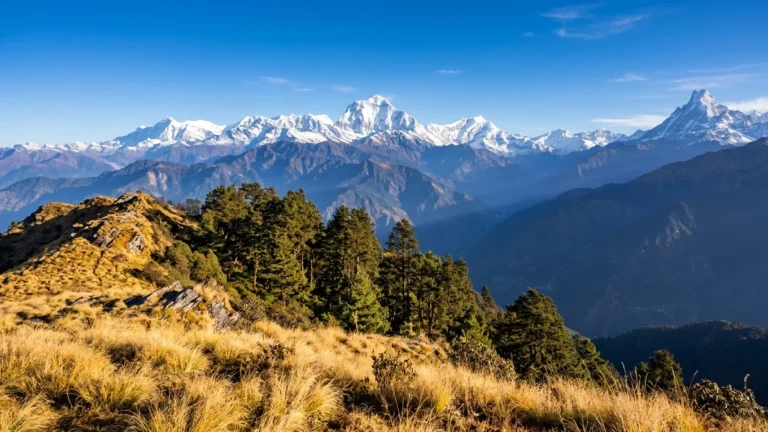
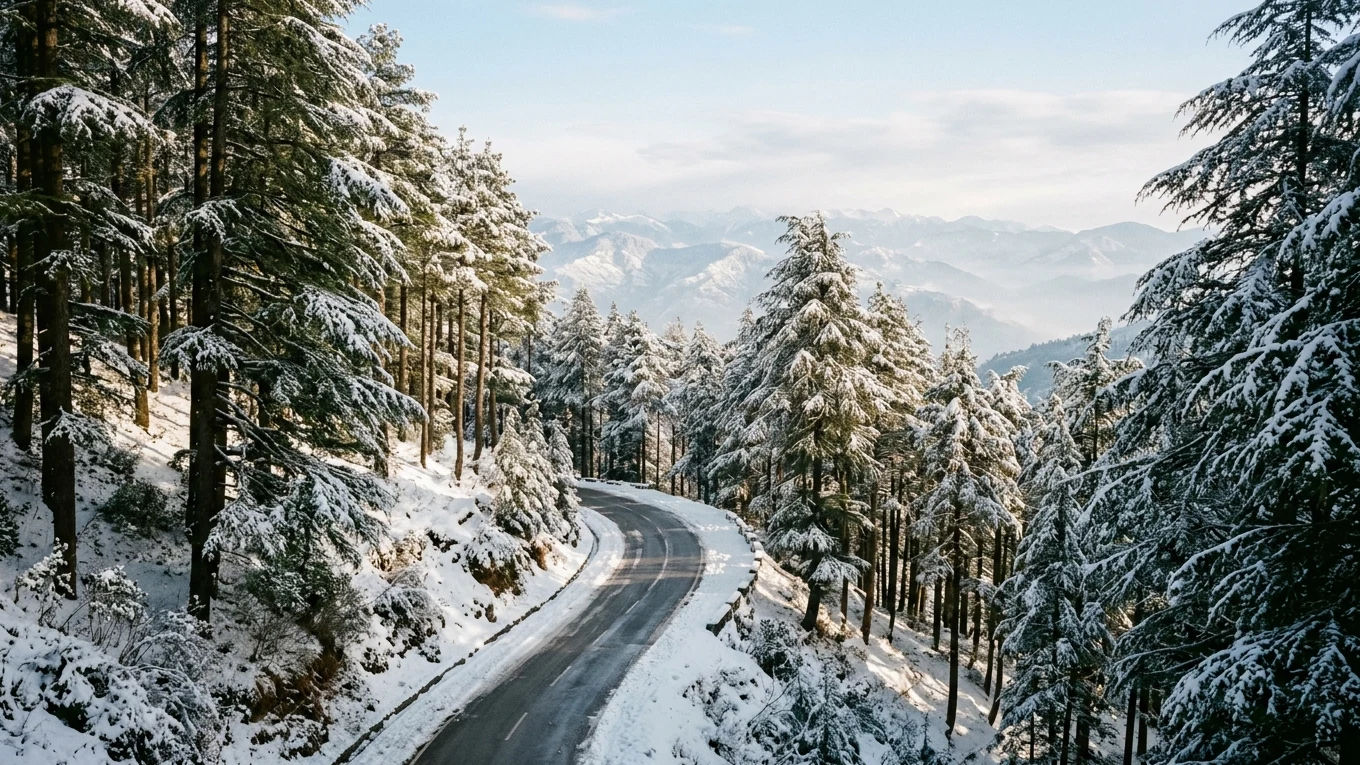
When Does It Snow in Chail? Perched at 2,250 meters (7,380 feet) in Himachal Pradesh’s Solan district, Chail experiences its historical snowfall window between late December and mid-February. Snowfall is episodic rather than continuous, governed by moisture-bearing Western Disturbances. January historically offers the highest likelihood of active snowfall and accumulation, while late December brings sharp sub-zero nights with periodic flurries. Typical winter temperatures range from daytime highs of 8°C to 12°C under clear sun to night lows between -2°C and 0°C (dropping lower following fresh snow). Snowfall cannot be guaranteed on specific calendar dates. For road travel, the 29-kilometer mountain ascent from Kandaghat via Sadhupul is prioritized for snow-clearing by the HP PWD and is strongly preferred over the higher Kufri ridge, which is prone to heavy snow and persistent black ice.
When Does It Snow in Chail? The Meteorological Winter Window
For Delhi NCR travellers seeking winter mountain tranquility without crowds, Chail is an ideal retreat. Perched at 2,250 meters (7,380 feet) in Solan district across the forested ridges of Rajgarh, Pandhewa, and Sadh Tibba, the town sits sheltered by deodar forests, 45 km southeast of Shimla and 29 km uphill from Kandaghat.
Snowfall in Chail is governed by Western Disturbances originating over the Mediterranean between December and March. Meeting cold Himalayan air, moisture precipitates as snow above 2,000 meters. Snowfall is episodic and weather-dependent: storms can deposit 15 to 30 centimeters of powder within 48 hours, while dry cycles bring sub-zero cold with sharp hoarfrost.
Understanding the monthly progression of winter allows travellers to plan realistically:
Early to Mid-December: The Onset of Mountain Chill
Day temperatures range from 10°C to 14°C (1°C to 4°C nights). Snowfall is very rare; roads remain dry, and morning hoarfrost glitters on pine needles with clear views of northern snow peaks.
Late December: Freezing Nights and Periodic Flurries
From December 20 through New Year, nights dip below freezing (-1°C to 2°C). Snowfall during Christmas and New Year is periodic rather than guaranteed, varying year to year. Expect sharp frost and freezing nights with occasional flurries rather than dependable drifts.
January: The Peak Snowfall Window
January represents the primary snowfall window, historically offering the highest likelihood of active snowstorms and forest accumulation. Day temperatures hover from 4°C to 9°C (-3°C to 1°C nights), marking the peak period for cold and road ice.
Early to Mid-February: Late-Season Snow and Lengthening Days
Early February remains a viable late-season snowfall window, with days recovering to 7°C to 12°C (-1°C to 3°C nights). Daylight thawing creates slush that refreezes after dusk.
Late February: Early Mountain Thaw
Snowfall becomes unlikely as days warm to 12°C to 16°C (2°C to 5°C nights). Lingering snow is confined to deep, shaded deodar gullies near high ridges as forests transition toward spring.
| Winter Window | Day Temperature | Night Temperature | Snowfall Likelihood | Typical Ground Conditions |
|---|---|---|---|---|
| Early to Mid-Dec | 10°C to 14°C | 1°C to 4°C | Very Low (Rare) | Dry roads, pine hoarfrost |
| Late Dec (Holidays) | 6°C to 11°C | -1°C to 2°C | Periodic / Variable | Hard frost, light flurries |
| January (Peak) | 4°C to 9°C | -3°C to 1°C | Peak Window | Active snow, forest powder, ice |
| Early to Mid-Feb | 7°C to 12°C | -1°C to 3°C | Moderate (Late Season) | Late snow, daytime slush, sun |
| Late February | 12°C to 16°C | 2°C to 5°C | Low (Unlikely) | Dry roads, shaded snow lingering |
How Much Snow Should You Actually Expect? Accumulation vs. Forest Frost
Travellers often confuse transient snowfall with permanent snow cover. In high valleys above 3,500 meters, snow stays frozen for months. On mid-altitude Shivalik ridges (2,000m to 2,300m), solar radiation accelerates daytime thawing even in mid-winter.
When an active Western Disturbance brings snow, accumulation typically ranges from 10 to 30 centimeters across town, with higher ridges near Kali Ka Tibba recording up to 40 centimeters. Once skies clear, open south-facing hillsides, asphalt roads, and sunny verandas thaw within 24 to 48 hours, while north-facing slopes and deodar canopies preserve compacted snow and frost for ten days or more.
In dry winter cycles, Chail experiences weeks of sub-zero cold without measurable snow, creating dazzling hoarfrost across meadows. Upvan advises travellers to embrace crisp mountain air and cozy cottage evenings, treating fresh snowfall as a seasonal bonus rather than a guaranteed certainty.
Chail Winter Road Conditions & Highway Safety Protocols
Reaching Chail from Delhi NCR in winter involves two distinct driving legs: the plains expressway of National Highway 44 (NH44) and the mountain climb from Kandaghat.
Chail is approximately 340 km from Central Delhi via NH44 and the Kandaghat mountain road. Under normal conditions, the drive takes 7 to 8 hours (7.5 to 8.5 hours from Gurgaon via the WPE). In winter, plan for 8.5 to 10 hours due to dense radiation fog across the Haryana plains.
Between late December and late January, NH44 between Sonipat and Ambala encounters dense morning fog between 4:00 AM and 8:30 AM. Departing Delhi around 6:30 AM allows you to cross the plains as fog lifts, reaching the Himalayan Expressway near Parwanoo by midday.
From Parwanoo, the four-lane mountain expressway (NH5) climbs past Solan to Kandaghat. Drivers turn right onto State Highway 8, a 29-kilometer paved two-lane mountain ascent winding past Sadhupul to Chail’s 2,250-meter ridge. Accessible to standard cars and SUVs in normal winter weather, this corridor is fully detailed in our comprehensive Delhi to Chail driving route guide.
Understanding Black Ice: The Invisible Winter Mountain Hazard
While visible snow prompts caution, the single most dangerous winter mountain hazard is invisible: black ice—a paper-thin, transparent glaze of frozen moisture forming directly on asphalt that drivers mistake for wet tarmac.
It forms when daytime melt, run-off, or condensation freezes as asphalt drops below 0°C. In the Solan hills, the primary hazard window extends from dusk through mid-morning. Shaded bends under dense deodar canopies can retain slick ice well into the day, requiring cautious entry speeds.
Tires lose significant traction on glazed ice, rendering abrupt braking largely ineffective. Essential safety protocols:
- Travel Midday: Drive mountain stretches between 10:00 AM and 4:00 PM when sun warms the road; avoid unfamiliar ascents after dark in active winter conditions.
- Engine Braking: Shift into lower gears when descending, using engine compression to regulate speed rather than riding the brakes.
- Increase Following Distance: Increase following distance behind preceding vehicles to preserve an ample stopping buffer on slick tarmac.
- Gentle Inputs: Accelerate smoothly, steer gently, and brake in a straight line before entering turns rather than mid-corner.
- Check Local Advisories & Road Crews: Verify same-day weather bulletins and road advisories before departing. HP PWD teams clear drifts and spread crushed rock dust on icy hairpins; reduce speed immediately when you spot spread grit.
Chail vs. Higher Snow Corridors: Why Route Choice Matters
When winter storms sweep Himachal Pradesh, approach routes behave differently by altitude. Branching south from Kufri ridge and crossing elevations exceeding 2,500 meters (over 8,200 feet) near Fagu, the alternative route suffers heavy snow and persistent black ice under dense deodar canopies. Administrations frequently issue advisories discouraging travel via Kufri during storms.
In contrast, the primary Kandaghat–Sadhupul–Chail ascent climbs gradually from lower valley elevations. HP PWD Solan classifies this corridor as an essential district lifeline connecting local communities to the national highway. Loaders stationed at Kandaghat and Sadhupul are mobilized as a priority. While active storms cause brief halts for plows, this corridor remains open far longer than higher ridge passes.
| Route Characteristic | Kandaghat–Sadhupul–Chail (Recommended) | Kufri–Chail Ridge Road (Avoid in Snow) |
|---|---|---|
| Maximum Route Elevation | Approx. 2,250 m (Chail ridge) | Exceeds 2,500 m (Kufri ridge) |
| Winter Road Classification | Major District Lifeline (HP PWD) | High-Altitude Secondary Spur |
| Snow-Clearing Priority | High priority; machinery at Kandaghat | Secondary priority; subject to storm delays |
| Black Ice Vulnerability | Moderate; shaded morning bends | High; prolonged ice in shaded canopy |
| Recommended Vehicle Type | Accessible to 2WD on dry/cleared roads | 4×4 or chains strongly advised in storms |
| Winter Advisory Status | Primary recommended corridor | Avoid during active storms or ice |
For visitors wishing to explore quiet walking paths and heritage points once roads are clear, our unhurried guide to Chail’s pine and deodar forest trails outlines scenic forest routes across all seasons.
Winter Wildlife & Walking Trails: Chail Wildlife Sanctuary
One of Chail’s winter highlights is its quiet forest canopy. Covering approximately 109 square kilometers of protected oak, pine, and deodar ridges, the Chail Wildlife Sanctuary is managed under the Shimla Wildlife Division of the Himachal Pradesh Forest Department.
Public forest roads and outer village trails through the sanctuary perimeter can be explored on foot without entry permits. When walking in winter:
- Observe Daylight Hours: The sanctuary is open during daylight hours (typically 7:00 AM to 6:00 PM). Twilight fades by 5:15 PM in January; finish trail walks by 4:30 PM.
- Ensure Trail Traction: Wet pine needles, leaves, and frost become slick. Wear sturdy hiking boots with deep rubber treads.
- Cheer Pheasant Conservation: The sanctuary is a recognized habitat for the vulnerable Cheer Pheasant (Catreus wallichii) and hosts a dedicated Cheer Pheasant Breeding and Rehabilitation Centre near Blossom and Jhajja. In winter, these birds forage on steep, south-facing grassy slopes where morning sun melts surface frost first. Maintain silence and avoid disturbing wildlife.
- Reserve Regulations: While perimeter walks carry no entry fee, venturing into core reserve trails or conducting specialized photography is subject to local forest range checkpoint regulations. The sanctuary enforces a strict zero-litter policy; pack out all waste.
Staying in Chail in Winter: Partner Cottages & Cold-Weather Living
Winter travel in the Himalayas calls for honest planning. In mountain hamlets, comfort depends on cottage construction, dependable bedding, and attentive management.
Chail Camps & Cottages is a curated partner property coordinated directly by Upvan Hotels & Resorts; Upvan acts as the reservation partner rather than the owner. Sheltered by pine and cedar trees, Chail Camps & Cottages offers authentic woodland lodging. Key winter details:
- Solid Wooden Cottages (Recommended): For winter getaways, Upvan recommends booking timber cottages with view balconies; solid wood paneling retains warmth far better than canvas tents during freezing nights.
- Alpine Swiss Tents (Primarily 3-Season): While canvas alpine tents operate during warmer months, canvas walls provide limited insulation in sub-zero weather. Tents are not recommended for deep winter; lodging focuses on timber cottages.
- Heating Arrangements: Solid cottages feature winter heating arrangements and heavy alpine bedding. Because appliance configurations and seasonal provisions vary, guests should confirm specific room heating setups with the booking desk when reserving.
- Running Hot Water: En-suite cottage bathrooms include running hot water; during severe sub-zero cold, supply may follow scheduled morning and evening hours to prevent frozen pipes. Guests should verify daily timing upon arrival.
- Generator Power Backup: On-site generator backup maintains essential lighting and device charging during power outages; heavy heating loads may be moderated during grid cuts.
- Gated On-Site Parking: Dedicated on-site parking keeps guest vehicles off narrow public snow roads and clear of municipal plows.
- Communal Evening Campfires: Campfires are organized in designated outdoor areas, subject to calm winds, dry weather, and fire safety protocols.
The Essential Winter Packing Checklist for Chail
Packing for Chail in winter requires a functional layering system, as temperatures swing by 12°C to 15°C between sunlit afternoons and freezing nights.
1. The Three-Layer Clothing System
- Base Layer (Moisture Management): Pack 2–3 sets of thermal innerwear (synthetic or Merino wool); avoid cotton, which retains moisture and accelerates body cooling.
- Mid Layer (Insulation): Pack 2–3 fleece pullovers, woolen sweaters, and fleece-lined trousers to trap radiant body heat.
- Outer Layer (Weather Barrier): Wear a windproof, water-resistant down jacket or heavy parka with an insulated hood against biting ridge winds.
- Extremities: Carry a woolen beanie, fleece neck gaiter, insulated gloves, and four pairs of heavy thermal socks.
2. Footwear & Anti-Slip Gear
Wear ankle-supporting hiking boots with deep-tread rubber outsoles (Vibram or cold-weather compounds); flat city shoes offer zero traction on frosted mountain trails.
3. Vehicle Winterization Kit
- Radiator Anti-Freeze: Ensure engine coolant contains a 50:50 anti-freeze mixture before leaving the plains to avoid overnight freezing and engine block damage.
- Winter Washer Fluid: Use low-temperature washer fluid to prevent spray from freezing on cold glass.
- Battery Load Testing: Test your battery prior to departure; sub-zero cold cuts cranking output by 30% to 50%, risking cold-start failures.
- Emergency In-Car Hardware: Carry jumper cables, a portable tire inflator, LED torch, ice scraper, and tow strap. Standard two-wheel-drive vehicles struggle on steep snow gradients; carry tire chains or utilize 4×4 capability during active storm alerts.
4. Personal Health & Electronics
- High-Capacity Power Banks: Sub-zero cold drains batteries rapidly; carry a 10,000–20,000 mAh power bank and keep devices in inner coat pockets close to body heat.
- UV Sunglasses & High-SPF Sunscreen: At 2,250 meters, snow reflects up to 80% of UV rays; pack UV-rated sunglasses and SPF 30+ sunscreen to prevent glare and sunburn.
- Vacuum Thermos Flask: Carry a 1-litre vacuum flask for hot water or tea on highway drives and trail walks.
- Travel First-Aid Essentials: Pack cold remedies, lozenges, lip balm, motion sickness medication, and personal prescriptions with reserve supply.
Who Should Plan a Winter Trip to Chail?
Chail in winter is an extraordinary escape, but it is best appreciated when your travel style matches mountain realities:
- Couples Seeking Seclusion: Warm wooden cottages, misty pine sunrises, quiet forest trails, and fireside evenings create an intimate mountain retreat far from commercial hill stations.
- Nature Photographers & Birdwatchers: Low winter sun casts golden shadows through deodar forests, while snow-dusted ridges offer striking landscapes. Dawn birding provides opportunities to observe Himalayan species.
- Thoughtful Road Trippers: For drivers who appreciate scenic, disciplined mountain roads, crisp alpine air, and unhurried rhythms, Chail provides the perfect winter recharge.
- Travellers Who Should Reconsider: If your vacation requires heated indoor pools, bustling shopping promenades, vibrant nightlife, or guaranteed deep snow on specific dates, larger centers like Shimla better match your preferences.
Frequently Asked Questions About Winter in Chail
Does it snow every winter in Chail?
Chail historically experiences snowfall between late December and mid-February. However, events are episodic: some winters bring multiple active snowstorms, while others bring dry sub-zero cold with sharp hoarfrost rather than deep drifts.
Is the mountain road to Chail open during winter?
The 29-kilometer mountain road from Kandaghat via Sadhupul is prioritized for snow-clearing by the HP PWD as an essential regional lifeline, remaining open far longer than higher ridge routes. Drivers should verify same-day road advisories and exercise extreme caution.
Can front-wheel-drive sedans and hatchbacks drive to Chail in snow?
Two-wheel-drive cars easily reach Chail on dry or cleared roads. During active snowfall over 5 centimeters, passenger cars lose traction on steep gradients; authorities recommend 4×4 vehicles or carrying tire chains.
How cold does Chail get at night during January?
In January, nights typically drop between -2°C and 0°C on clear nights, dipping to -4°C or lower after fresh snow. Daytime temperatures remain pleasant under clear sunshine, ranging between 4°C and 9°C.
What is the difference between visiting Chail in December versus January?
December brings crisp, dry weather, clear skies, and very low early snow probability, with periodic flurries near New Year. January brings deep-winter cold, the highest snowfall likelihood, colder nights, and snow-covered forests.
Are cottage accommodations heated in Chail during winter?
Solid wooden cottages at partner properties like Chail Camps & Cottages feature winter heating arrangements and heavy alpine bedding. Because exact room setups vary, guests should confirm current heating arrangements with the booking desk when reserving.
What should I do if my car hits a patch of black ice?
If your vehicle encounters black ice, stay calm and never slam on the brakes. Gently lift off the accelerator, avoid sudden steering turns, coast straight until traction returns, and use gentle low-gear engine braking.
Plan Your Winter Mountain Getaway with Upvan Concierge
A winter journey into the Shivalik foothills should be peaceful, grounding, and completely transparent. At Upvan Hotels & Resorts, we believe memorable mountain travel begins with honest guidance, authentic partner relationships, and meticulous on-ground coordination.
Whether you are planning an unhurried couple’s escape beneath the deodar canopies of Chail Camps & Cottages, exploring our curated Chail destination guide and stays, or discovering peaceful hill stations near Delhi across Himachal Pradesh and Uttarakhand, our team is here to assist. Connect directly with our team through the Upvan Concierge Desk for current weather and road-condition guidance, partner booking coordination, and personalized winter trip-planning assistance.
Plan Your Mountain Retreat with Upvan
Experience handpicked mountain resorts, pine-sheltered cottages, and riverside sanctuaries across Himachal Pradesh, Uttarakhand, and near Delhi NCR. Enjoy verified hospitality, best direct rates, and personalized mountain itineraries.