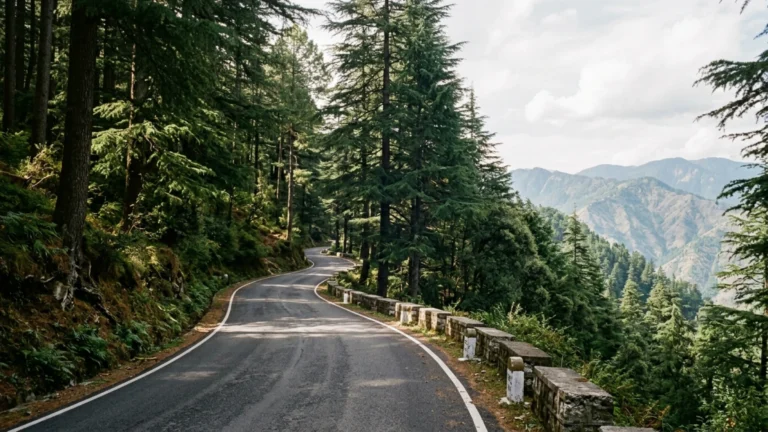
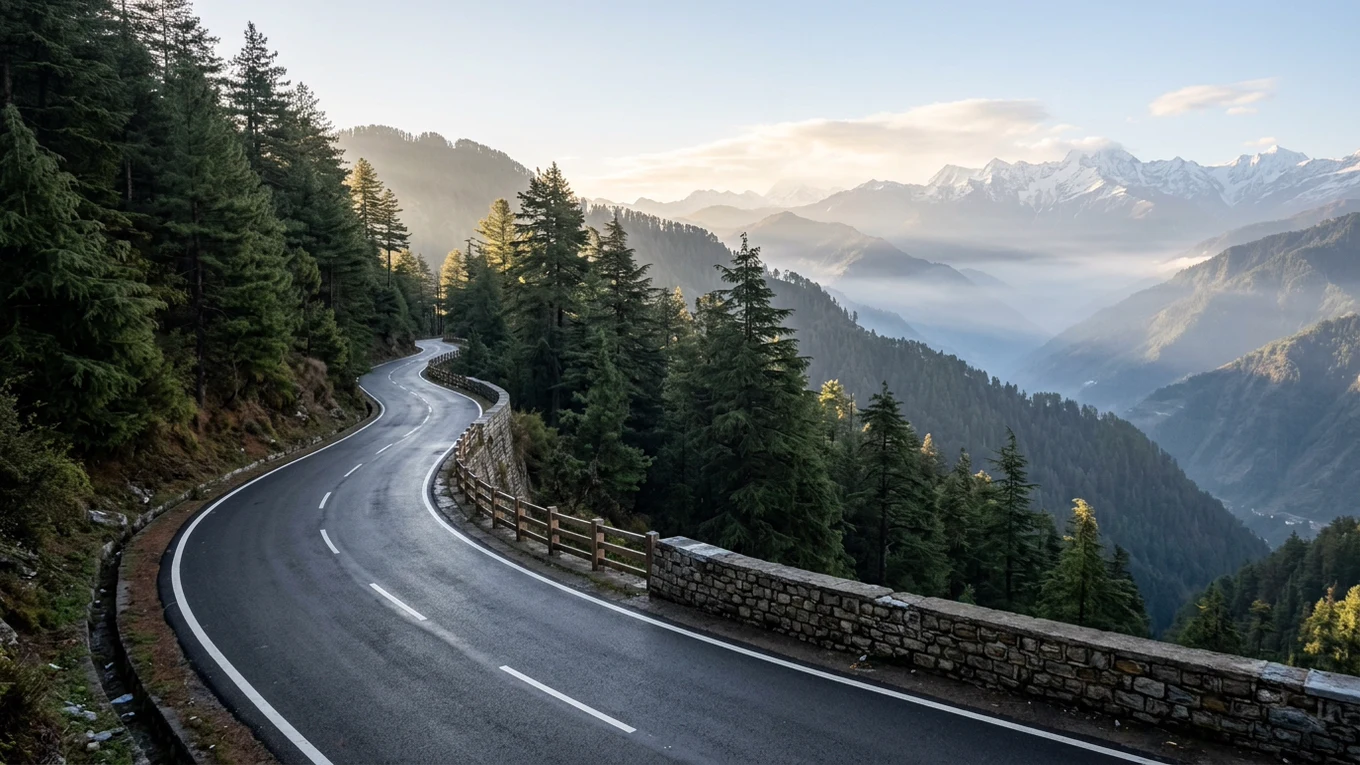
Core Himalayan Driving Protocols: Safe mountain driving combines controlled service braking with engine braking in an appropriate lower gear (such as 2nd or 3rd gear) on sustained descents to help manage vehicle momentum and prevent overheating the brakes. Under Regulation 21 of the Motor Vehicles (Driving) Regulations, 2017, where a mountain or steep road is insufficiently wide to allow free crossing of vehicles, the driver proceeding downhill must stop to the left and give way to the vehicle proceeding uphill. Drivers must also maintain due care and caution, observe all road signs and directions from traffic personnel, never overtake on blind curves, never coast in neutral, and use low beams with fog lamps in mountain mist.
For motorists accustomed to the wide, multi-lane expressways of Delhi NCR, entering the Himalayan foothills presents a dramatic mechanical and psychological shift. The moment your wheels leave the smooth asphalt of national highways and begin climbing the Shivalik and lower Himalayan gradients of Himachal Pradesh or Uttarakhand, the rules of driving change fundamentally.
Centrifugal force, steep 10% to 18% gradients, blind hairpin curves, sudden weather shifts, and narrow single-lane bottlenecks demand deliberate technique rather than speed. Driving in the mountains is neither dangerous nor intimidating when approached with proper respect for road physics and established mountain etiquette. For travellers planning an unhurried road trip into the hills, you can explore our curated Himalayan destination guides and tranquil retreats near Delhi to match your itinerary to comfortable driving stages.
This comprehensive guide details the non-negotiable safety protocols every first-time mountain driver must know before tackling Himalayan highways—covering transmission control, braking mechanics, right-of-way rules, and seasonal precautions.
1. Master Engine Braking: The First Law of Mountain Descents
One of the most frequent errors made by plains drivers on mountain roads is continuously resting their foot on the brake pedal (“riding the brakes”) throughout sustained downhill descents. On steep hill highways—such as descending from Dharampur toward Kalka, Suwakholi toward Dehradun, or Chail toward Kandaghat—gravity continuously pulls the vehicle forward. Relying exclusively on the service footbrake to control downhill speed generates severe, continuous thermal stress across the braking system.
Understanding Brake Fade vs. Hydraulic Vapor Lock
To safeguard your vehicle on mountain descents, it is vital to distinguish between the friction temperatures of brake pads and discs, and the hydraulic boiling point of brake fluid inside the calipers:
- Brake Pad and Rotor Overheating (Brake Fade): Continuous friction braking causes the contact surfaces of brake pads and steel discs to escalate into hundreds of degrees Celsius. Under sustained thermal stress, the binding resins in friction linings can break down and form a glazed, low-friction surface. When brake fade sets in, the pedal may still feel firm, but braking efficiency drops sharply, demanding far greater pedal effort to achieve even modest deceleration.
- Brake Fluid Boiling and Vapor Lock: Intense heat from the friction interface transfers through the caliper pistons into the hydraulic brake fluid. Automotive brake fluid is manufactured to strict boiling point standards. Under standard formulations (such as DOT 3 and DOT 4 specifications documented by automotive manufacturers like Honda and lubricant refiners like Bharat Petroleum):
• Fresh ‘dry’ brake fluid has a minimum boiling point of approximately 205°C (401°F) for DOT 3, and 230°C (446°F) for DOT 4.
• Because conventional glycol-based brake fluids are hygroscopic, they naturally absorb moisture from ambient air over time. Water contamination lowers the boiling point toward the ‘wet’ boiling point threshold—approximately 140°C (284°F) for DOT 3 and 155°C (311°F) for DOT 4 (varying by fluid formulation and age).
When caliper temperatures exceed the boiling point of the fluid in the lines, the fluid vaporizes into gas bubbles. Because vapor is compressible whereas liquid is not, depressing the pedal compresses the vapor rather than displacing caliper pistons. This condition—known as vapor lock—causes the brake pedal to feel spongy or sink toward the floor, resulting in severe loss of stopping force.
How to Combine Engine Braking and Service Brakes on Descents
A time-tested guideline for downhill mountain driving is to select an appropriate lower gear suited to the steepness of the descent. Drivetrain and engine retarding resistance provide continuous auxiliary retarding force, helping manage vehicle momentum without continuously riding the footbrake:
- Service Brakes Remain Primary for Active Stopping: Engine braking is not a substitute for the service brakes when you need to slow down or stop. Rather, engine compression and drivetrain resistance help govern baseline downhill momentum, reducing thermal strain so your service brakes remain cool and fully responsive when active deceleration is required.
- Select an Appropriate Lower Gear: Before beginning a sustained downhill grade, use your service brakes to decelerate smoothly to a controlled speed suited to current road conditions, then shift into an appropriate lower gear (such as 2nd or 3rd gear in a manual transmission, or the manufacturer-recommended manual or low mode). Always follow vehicle-manufacturer recommendations regarding gear selection, transmission modes, and safe downhill operating speeds.
- Drivetrain Retarding Resistance: With your foot off the accelerator pedal, internal engine compression, mechanical drag, and drivetrain resistance (or regenerative braking in hybrid and electric powertrains) counteract gravitational acceleration. This retarding force helps maintain a steady, manageable pace suited to the specific road gradient, curvature, visibility, and surface traction.
- Engine RPM Behavior Varies by Vehicle: Tachometer readings will naturally rise higher than during flat-road cruising as the drivetrain turns the engine. The exact operating RPM range depends entirely on your vehicle’s engine type (petrol engines generally operate across higher RPM bands than lower-revving diesel engines), transmission gearing, and vehicle load. Ensure engine speed remains within a safe operating window and well below the manufacturer’s redline.
- Brake Decisively and Intermittently: Safe driving speed must always adapt dynamically to road gradient, weather, road surface, visibility, and traffic density. When approaching sharper curves, negotiating tight hairpins, or needing to shed excess speed, apply the service brake firmly and smoothly to decelerate, then release the pedal completely once speed is adjusted. This intermittent technique allows surrounding airflow to dissipate friction heat between braking events, rather than generating continuous thermal buildup.
Engine Braking in Automatic, AMT, and CVT Vehicles
Automatic transmissions naturally upshift when you lift off the accelerator, which causes the car to free-roll and gain dangerous downhill speed if left in standard Drive (‘D’). Every automatic vehicle provides manual override controls designed specifically for hill driving:
- Manual Mode / Tiptronic / Paddle Shifters: Slide your gear selector into ‘M’ (Manual) and use the gear lever or steering-wheel paddle shifters to downshift into 2nd or 3rd gear. Modern transmissions will hold the selected lower gear until you manually upshift.
- Low Mode (‘L’ or ‘B’): On CVT and hybrid vehicles, shifting into ‘L’ (Low) or ‘B’ (Braking) forces the transmission into its lowest pulley ratio and engages maximum engine and regenerative braking.
- Numbered Lower Gates (3, 2, 1): On traditional 4-speed automatics, shift the lever out of ‘D’ into ‘2’ or ‘L’ for steep descents.
Critical Safety Prohibition: Never Coast in Neutral
Never put your transmission into Neutral (‘N’) or hold down the clutch pedal while driving downhill to “save fuel.” In neutral, your vehicle is entirely disconnected from engine resistance, wheels free-roll under pure gravitational acceleration, power steering assist can be compromised, and you have zero emergency throttle response.
2. Mountain Road Priority & Passing Rules: Regulation 21 Explained
On mountain highways and steep gradients, vehicle passing priority is governed by specific statutory rules. In India, this is codified under Regulation 21 of the Motor Vehicles (Driving) Regulations, 2017 (notified under Section 118 of the Motor Vehicles Act, 1988):
“On mountain roads and steep roads, where the road is not sufficiently wide to allow the free crossing of vehicles, the driver of the vehicle proceeding downhill shall stop his vehicle to the left of the road and give way to the vehicle proceeding uphill.”
This statutory requirement is not an unconditional or unlimited rule applicable to every possible road situation. Crucially, the rule applies specifically where the roadway is not sufficiently wide for vehicles to cross each other freely. Furthermore, Regulation 21 explicitly mandates that every driver on a mountain or steep road must:
- Drive with due care and caution at all times;
- Observe road signs and follow directions given by any authorized traffic personnel;
- Never overtake any vehicle on a curve or bend where the view ahead is obstructed.
The Mechanical and Safety Rationale
The practical engineering logic behind this regulation is grounded in vehicle dynamics. Restarting an ascending vehicle on a steep 10% to 18% incline requires delicate clutch coordination, immediate engine torque, and careful momentum control. If an ascending vehicle is forced to come to a complete stop on a narrow grade, restarting risks rolling backward, stalling, or causing severe clutch plate wear. By contrast, a descending vehicle can bring its momentum to a controlled stop on the left, hold its position safely using service brakes and the handbrake, and resume movement with gravitational assistance once the road ahead is clear.
Yielding and Passing on Single-Lane Roads
On narrower interior mountain corridors—such as secondary roads leading through pine ridges and rural circuits—the paved asphalt may only accommodate one vehicle at a time. Safe passing requires cooperative driving discipline:
- Anticipate Passing Bays: Maintain constant visual scanning 50 to 100 meters ahead. Watch for widened paved sections or dirt shoulders (passing bays) cut into the hill.
- Pull In Early: If you are descending and see an ascending vehicle approaching, pull into the nearest passing bay on your left well before you meet. Stop and allow the ascending car to pass uninterrupted.
- Never Pull Onto Soft Mud: When pulling aside, ensure the shoulder is solid asphalt or compacted gravel. Avoid soft unpaved cliff edges, loose mud, or deep unpaved drains after rainfall.
- The Heavy Vehicle Exception: Regardless of direction, always yield right of way to heavily loaded trucks, state transport buses (HRTC, UTC), and emergency vehicles. Commercial drivers have limited maneuverability, large blind spots, and wide turning arcs on tight hairpin corners.
3. Cornering Discipline & Blind Hairpin Bends
Himalayan roads are defined by continuous reverse curves, sweeping mountain bends, and steep 180-degree hairpin turns (‘switchbacks’). Navigating these requires strict lane discipline and precise vehicle positioning.
Never Cut Corners Across the Centerline
On plains roads, drivers often “straighten” gentle curves by drifting across the center lane divider. On a mountain road, cutting the centerline on a blind curve is the leading cause of fatal head-on collisions. Always assume an oncoming vehicle or local bus is approaching around the curve just out of sight. Keep your entire vehicle firmly within your left lane throughout the entry, apex, and exit of every bend.
The Three-Stage Cornering Protocol
Professional mountain driving relies on smooth, sequential vehicle control:
- Brake and Shift in a Straight Line: Complete all braking and gear downshifting before you turn the steering wheel. Slow down to a safe, controlled speed suited to the curvature of the turn, gradient, visibility, and vehicle stability while your wheels are still straight.
- Coast or Hold Neutral Throttle at the Apex: Once entering the turn, keep both hands firmly on the steering wheel at the 9-and-3 position. Do not brake mid-corner, as braking while turning can unload the rear axle and induce understeer or oversteer on gravel.
- Accelerate Only on Exit: As the front wheels begin straightening out toward the road exit, apply smooth, gradual accelerator pressure to pull the car cleanly through the climb.
Daytime Horn and Nighttime Light Signaling
Auditory and visual communication are vital on winding mountain corridors:
- Daytime Blind Curves: When approaching any blind corner, rock outcrop, or steep hairpin where you cannot see the road ahead, tap your horn with two short, crisp beeps. Avoid continuous aggressive honking; short taps alert oncoming traffic without creating noise pollution in quiet valley sanctuaries.
- Nighttime Switchbacks: At night, headlights provide superior advance warning. As you approach a blind hairpin, flick your headlight stalk to flash your high beams twice. The reflection of your lights sweeping across the opposite rock face will warn oncoming drivers of your approach long before your car becomes visible.
4. Clutch Management & Preventing Clutch Burnout on Inclines
Clutch failure is one of the most common mechanical breakdowns reported by first-time mountain road trippers. Prolonged “half-clutching” (holding the clutch pedal partially depressed to balance the car on a hill) generates intense heat that disintegrates the friction disc lining, producing a sharp, pungent burning odor.
The Handbrake Hill-Start Technique
Every mountain driver should practice and master the traditional handbrake hill-start before traveling to the hills:
- When stopped facing uphill, pull the handbrake up firmly to hold the vehicle completely stationary. Move your right foot off the brake pedal and hover over the accelerator.
- Depress the clutch pedal and engage 1st gear.
- Gently press the accelerator to raise engine speed slightly above idle, providing sufficient initial torque tailored to your vehicle’s engine type and cargo load.
- Gradually release the clutch pedal until you reach the ‘bite point’—you will feel the engine note deepen and the rear of the car settle slightly as the engine attempts to pull forward.
- Hold your clutch pedal completely still at that bite point, and smoothly release the handbrake lever. The vehicle will pull forward up the hill smoothly without rolling backward an inch.
- Once moving, release the remaining clutch travel smoothly and build forward momentum.
If you drive a vehicle equipped with an electronic Hill-Start Assist (HSA) system, remember that HSA typically holds brake pressure for only 2 to 3 seconds after you lift your foot off the brake pedal. Do not hesitate; coordinate your throttle and clutch inputs decisively.
5. Essential Pre-Trip Vehicle Inspection Checklist
A vehicle that functions satisfactorily on city streets may suffer mechanical distress under the thermal and gravitational stresses of mountain ascents. Complete these mechanical verifications 48 hours before departing Delhi NCR:
| Inspection Point | Required Standard | Mountain Driving Impact |
|---|---|---|
| Brake Pads & Fluid | Minimum 4 mm pad thickness; clear, unclouded brake fluid | Worn pads reduce friction capacity; moisture contamination depresses fluid boiling point, increasing vapor lock risk under sustained downhill heat. |
| Tire Tread Depth | Minimum 3.5 mm tread across all four tires | Essential for wet asphalt, loose roadside gravel, and steep hairpin traction. |
| Tire Pressure & Spare | OEM cold pressure; fully inflated spare tire (Stepney) | Tire sidewalls endure severe lateral flex on curves; rocky roads increase puncture risk. |
| Engine Coolant | 50/50 ethylene glycol mix at ‘Max’ line; never pure water | Sustained uphill climbing under heavy load generates substantial engine heat; sub-zero nights risk radiator freezing. |
| Wipers & Washer Fluid | Supple rubber blades; reservoir filled with bug/grime cleaner | Mountain fog, pine sap, and sudden drizzle rapidly streak glass if wipers are worn. |
| Emergency Equipment | Jack, wheel wrench, reflective triangle, wooden wheel chock | Changing a flat tire on an incline requires a solid wooden block to chock wheels securely. |
When packing your vehicle, keep heavy luggage centered low in the boot directly over the rear axle. An overloaded roof rack raises your vehicle’s center of gravity, inducing excessive body roll and instability when negotiating rapid S-curves.
For drivers coordinating an extended mountain road trip, planning moderate daily driving legs of 150 to 250 kilometers ensures you arrive relaxed and well before dusk. You can browse unhurried weekend getaways from Delhi to compare scenic road corridors across Shivalik and Garhwal hill circuits.
6. Navigating Weather & Seasonal Mountain Hazards
Himalayan weather changes rapidly across elevation bands. A sunny, clear afternoon in the foothills can transition into dense ridge fog or a torrential downpour within thirty minutes.
Mountain Fog and Mist Protocols
Dense mist frequently blankets mid-altitude ridges between 1,800 and 2,500 meters during post-monsoon and autumn months. When visibility drops below 30 meters:
- Never Turn On High Beams: High beams illuminate the microscopic moisture droplets suspended in the air, creating a blinding white glare that reflects straight back into your eyes. Switch to low beams and illuminate your dedicated amber fog lamps.
- Follow Road Markings: Keep your gaze focused on the white or yellow edge line on the left shoulder of the road. If the road lacks painted markings, follow the stone retaining wall or roadside crash barriers at a safe, reduced speed.
- Do Not Drive with Hazard Lights On: In India, many motorists erroneously switch on their 4-way hazard lights while moving through fog. Hazard lights indicate a stationary, broken-down vehicle. When your hazard lights are flashing continuously, you cannot use your turn indicators to signal an impending turn or pull-aside, confusing trailing drivers.
Monsoon Rain, Mud Slicks & Landslide Awareness
During the monsoon months (July through August), saturated mountain slopes can release mud, gravel, and loose boulders (‘shooting stones’):
- Watch for Debris in the Outside Lane: Fresh small pebbles scattered across an asphalt curve are an immediate warning sign that an overhead cutting is unstable. Reduce speed, avoid stopping directly beneath steep vertical rock cuttings, and proceed cautiously past the sector.
- Never Drive Through Mountain Torrent Crossings (Rahas): Heavy mountain cloudbursts create rapid seasonal torrents across the road. Even 15 centimeters of fast-flowing water can sweep a vehicle off a hillside edge. Wait safely on a secure section until local authorities or road clearance crews verify the crossing.
Winter Driving & Black Ice Caution
In high-altitude hill stations during December and January, moisture on the road freezes overnight into transparent “black ice.” Black ice is most prevalent in shaded valleys, northern mountain slopes that receive no morning sunshine, and across bridge decks:
- If the outdoor ambient temperature gauge drops below 3°C, treat all wet-looking or glossy patches of dark asphalt as ice.
- Do not make sudden steering inputs, aggressive accelerations, or hard braking. Maintain a large following distance (at least 50 meters) behind the car ahead, and let engine braking govern your speed.
7. Real-World Mountain Driving Scenarios Across Popular Corridors
Different Himalayan highway corridors present distinct driving characteristics. Applying these core safety principles to specific routes ensures a predictable, confident journey:
The Shivalik Ascent: Kalka to Shimla & Chail (NH5 & Rural Links)
The climb from Parwanoo through Dharampur to Kandaghat along the four-lane Himalayan Expressway is wide and well-graded, but transitions into narrow two-lane mountain roads the moment you exit toward Chail. On the rural ascent via Sadhupul, roads are curvy and flanked by deodar forests. Practicing engine braking and staying strictly within your lane is crucial as you navigate the quiet bends detailed in our Delhi to Chail driving route guide.
The Garhwal High Ridge: Dehradun to Dhanaulti
Climbing from the Dehradun valley toward the Mussoorie ridge and onward through Suwakholi presents steep, continuous switchbacks ascending over 2,200 meters. The narrow, winding pass demands disciplined uphill passing compliance and steady gear selection, as outlined in our practical Delhi to Dhanaulti road trip guide.
Evaluating Corridors for First-Time Hill Drivers
If this is your very first mountain road trip, select a route that matches your comfort level. Foothill destinations like Kasauli offer gentler, shorter hill climbs (under 12 km of winding ascent from Dharampur), whereas remote high-altitude ridges like Chakrata or Kanatal require 60 to 90 kilometers of sustained mountain motoring. For a comparative overview of driving times and terrain profiles across five distinct regional corridors, consult our guide to 5 mountain getaways from Delhi under 7 hours.
Himalayan Road Trip Planning & Concierge Support
Planning a self-drive holiday through Himachal Pradesh or Uttarakhand? The Upvan concierge team provides verified seasonal route advisories, realistic driving schedules, and secluded nature retreat bookings tailored for self-drive motorists.
8. Frequently Asked Questions for First-Time Himalayan Drivers
Is a small hatchback or front-wheel-drive car safe for Himalayan mountain roads?
Yes. Most standard front-wheel-drive hatchbacks and sedans handle paved Himalayan national and state highways with ease. Front-wheel drive provides excellent steering pull on uphill asphalt corners because the engine weight rests directly over the driving wheels. The crucial factor is not 4WD capability, but sensible driving technique: staying in lower gears, avoiding half-clutching, and maintaining adequate ground clearance over rough road patches.
Why should I never drive downhill in neutral (coasting)?
Coasting in neutral disconnects the engine from the transmission, eliminating all engine braking. Gravity will rapidly accelerate your vehicle down the slope, forcing you to rely 100% on friction brakes. This causes extreme brake overheating, pad glazing, and potentially total brake failure (vapor lock). Furthermore, in neutral you have no emergency throttle control to accelerate out of a hazard.
What should I do if my brakes start smelling burnt or feeling soft?
Immediately find a safe, wide roadside pull-off or passing bay on the hill side of the road. Shift into 1st gear (or ‘P’ in an automatic), engage the handbrake firmly, and place a wooden block or stone behind your tires. Do not touch the wheels or splash cold water on the brake discs, as sudden thermal shock can warp or crack the rotors. Turn off the engine and let the braking assembly cool naturally in ambient air for at least 30 to 45 minutes before proceeding cautiously in low gear.
How many kilometers should I plan to drive per day on mountain roads?
Actual travel pace on winding two-lane mountain roads is significantly slower than plains highways, with average journey progress often averaging between 25 and 35 km/h when accounting for curves, gradient ascents, passing stops, and local traffic. Safe driving speed varies continuously depending on road gradient, lane width, surface conditions, weather, visibility, vehicle type, and manufacturer guidelines. For realistic trip planning, a 100-kilometer mountain stretch typically requires 3.5 to 4.5 hours of journey time. Limit your hill driving to 150–250 kilometers per day, depart early in the morning, and aim to arrive at your destination before sunset to avoid navigating unfamiliar ghats in darkness.
Should I keep my air conditioning on while driving uphill?
On steep continuous ascents, especially in small-displacement or naturally aspirated engines, the air conditioning compressor saps substantial engine power and increases coolant temperature. Turning off the A/C frees up power for climbing and reduces engine thermal load. Roll down your windows to enjoy the fresh pine air, and turn on the cabin blower if needed to demist windows.
Plan Your Mountain Retreat with Upvan
Experience handpicked mountain resorts, pine-sheltered cottages, and riverside sanctuaries across Himachal Pradesh, Uttarakhand, and near Delhi NCR. Enjoy verified hospitality, best direct rates, and personalized mountain itineraries.